

We're Doing Birthdays Wrong.
A Pitch for Birthdate Nationalism. And: "The State of the Dayborhood."


Despite being my 37th birthday overall, today was my first ever summer birthday1. Such is a perk of the Southern Hemisphere, where I’m continuing to prepare for a conference presentation in Buenos Aires. My presentation will be about more humanistic ways to sample the world’s population in surveys based on geography, but today’s newsletter focuses less on spatial segmentation and more on temporality!
Specifically, I’m going to try to make a case for thinking of birthdays more collectively, imagining how a simple connection like a shared birthday can stitch together a global community. Because it’s not just my birthday today. Many have this day as their birthday. And as my birthday gift to others celebrating their 37th year, I’d like to increase the sense of connection between all of us in our cohort.
What Is “Birthday Nationalism”?
In general, we think of birthdays as our uniquely special day, and it’s rare to know people with our exact date of birth. Not just “the same birthday”, which is more common, but the full year-month-day combo. I personally only know of one person! Often we think of our birthday as something that is particularly ours; we don’t want to share it. But in a world where we all are feeling increasingly alienated from each other, the birthday could be a tool of shared identity -- one that cuts across and interweaves with other traditional identity constituencies.
We feel close to people who were born in and grew up in the same places that we did. But this “closeness” is in some sense a misconception.
Due to a mix of Earth’s axial rotation, its orbit of the sun and the sun’s spiraling around our galaxy, very few of us are actually born near each other in an absolute sense. For example, someone born 24 hours after me in the exact same city as me would have actually been born ~20 million miles2 away cosmically; they’d be much closer if they were born at the same time as me on the other side of the planet -- Perth, Australia is roughly 11,400 miles from where I was born in Florida, as far away a city as you can find on Earth, but it’s over 1,000x closer.3 With cosmic distance, where you are born is mere noise; it’s all about when you were born.
It’s for this reason that I believe we should feel more of a kinship with those who share a particular date of birth. Though you’ll never return to that part of space Earth occupied when you were born, that space still exists and ties together those born then.
I call the region of space where a day’s worth of the human population was born a “Dayborhood”. In this sense, we are all diaspora populations far from home. And so “Birthday Nationalism” imagines a sort of community created by the shared spatial origin, and extends the same logic of association and community that we’re familiar with in geographic “nations”.4
As for my birthday, I like to imagine this cross-section as the Republic of February Twenty-Seventh Nineteen Eighty-Nine (RoFTSNEN5).
I don’t think I currently have any subscribers from this particular corner of the cosmos, but I’m hopeful that walking through an exercise imagining this community as cohesive and cooperative is instructive or at least interesting. And you don’t need to have my particular birthday to help make my birthday wish come true.
A Birthday Wish
As you know, on our birthdays we are supposed to make wishes, and so I have a wish. And I’m not allowed to share what it is, for such are the rules with birthday wishes, but without sharing the desired outcome, I can still provide guidance on how you can help actualize this wish.
If you know anyone who was born on February 27th, 1989, please share this newsletter with them!6 You can send them something like this: “Some weird guy on the internet is trying to connect all of the people born on February 27th, 1989 and I thought you might want to know. Here’s the link: substack.middlingcontent.net/p/the-state-of-the-dayborhood.” It would be much appreciated!7
This next section is primarily for anyone who happens to share my particular date-of-birth. Other people can read it too though if they want; hopefully it demonstrates how this kind of community-building exercise can be at least amusing.
“My Fellow RoFTSNENians…”
If my wish has come true, hopefully this message has found its way to at least a few others born on February 27th, 1989.
In full, we are a diverse sample of the planet’s people. At earliest, some of us could have been born at midnight in Kiribati (+14 UTC), and others could have been born just before midnight on Baker Island (-12 UTC). That just-short-of-50-hour8 range covers a good length of Earth’s cosmic arc through space -- over 40 million miles! (Or 65 million km, which I guess is what most of you prefer?)
I say this to recognize we cover much ground among us, even within our distinct subset of outer space where we all breathed our first breath. And we also cover much ground in the work we do! From Wikipedia, I’ve learned a good amount about us as a constituency! We seem to be prolific specifically in athletics, music and the visual arts.
Achievements in Athletics
Athlete seems to be by far the most common profession among the Wikipedia-documented of us! Mostly retired, which I suppose makes sense for us all turning 37 today, but still I want to call out some past successes -- if only I was following everyone here a decade ago, I would have witnessed some pretty impressive wins!
As a community, we have a full set of Olympic medals! Stephen Kiprotich of Uganda won the gold medal for the Marathon at the London Olympics; Varlam Liparteliani won the silver in Judo at the Rio Olympics; and Koo Ja-cheol of South Korea won an Olympic bronze in 2012 (and also captained his National Team at the 2014 FIFA World Cup).
Kento Miyahara won his 7th Triple Crown Heavyweight Championship in September of last year, and defended it as recently as this past Monday in Tokyo.
Also in Tokyo this year, Richard Ringer of Germany finished 13th in the Marathon at the 2025 World Athletics Championships that took place there in September.
Muhammad Inam is a two-time Commonwealth Games wrestling champion who is now secretary of the Pakistan Wrestling Federation.
Takahiko Kozuka is a Japanese figure skater! Nina Haver-Løseth is a Norwegian alpine ski racer! Anna Vozakova is a Russian beach volleyball player!
Carter Jones is an American road-racing cyclist! David Fletcher is a British mountain biker! Donato De Ieso is an Italian cyclist!
Anna Punko is a Russian handball player! Henrique Teixeira is a Brazilian handball player! Alen Ovčina is a Bosnian handball player! Petit Minkoumba is a Cameroonian weightlifter! Emil Stær is a Danish sprint canoeist!
Aurélie Groizeleau was on the French National Rugby Team, then became a referee in 2021. (Her Wikipedia says she “breeds 7,000 pairs of pigeons at her parents’ house” -- that’s 14,000 pigeons!)
There are lots of footballers! Vitalij Lux is a footballer! David Button is a footballer! Facundo Moreira is a footballer! Amir Abu Nil is a footballer! Carolyne Anyango is a footballer! Ivan Matošević is a footballer! Lloyd Rigby is a footballer! Charles Johnson and James Shaw are football players, which is what footballers are called in American football! This isn’t even all the footballers9; there are some birthday discrepancies that are causing me to omit some names. There are so many footballers!
Making Much Music
There are also quite a few of us in music! I’ve enjoyed listening to songs from us while writing this email, and I wanted to share some highlights from this past year in particular! We’re quite creatively productive as a community!
Hurricane Chris, who you probably remember as the singer of the 2007 #7 Billboard crunk hit “A Bay Bay”, released a new album last year, Hurricane Season 2.5!
Shota Shimizu released a new album last summer (Pulsatilla Cernua) and released the tour album for that record today -- on our collective 37th birthdays! (We did not directly collaborate on this, but I’m delighted by the happenstance!)
Peruvian singer Leslie Shaw released a deluxe version of her 2024 record Hay Niveles just last October!
Sam Sweeney is on tour and is playing in London in April for any FoFTSNENians in the area. (He has a song on the soundtrack of About Time10, which I specifically remember enjoying when I saw the movie in theatres; I didn’t even realize we were birthday-brethren at the time!)
Esther Huang is in the film 功夫 -- it just came out over the Chinese New Year holiday but I haven’t seen it yet! (She was a member of the Taiwanese girl group Hey Girl!)
Eurovision competitor Jessika Muscat, who competed in 2018 with the submission “Who We Are”, released a new song “Empire” in June of last year!
American Idol Season 10 competitor Stefano Langone released two new singles this past year, the more-listened-to of which is “Celebration”!
While I couldn’t find anything recent from him, Kristof Hering finished in sixth place in the ninth season of Deutschland sucht den Superstar in 2012! He’s still singing somewhere I expect?
Visual Arts Victories
And if you’re looking for something to watch, you’ll be happy to hear that our Dayborhood is also active in visual arts! Here’s a sampling!
Matt Lapinskas, best known for his role of Anthony Moon in the BBC sitcom EastEnders, was in the film Dream Hacker that came out in June!
Mike Castle voiced a character in the short film MRI (or, Michael Returns Indefinitely) released last October, and he has a songwriting credit on “I Hated Love Songs” on a Dan Mangan album released last May!
Arabelle Raphael11 won an award for “Favorite Inked Model” in May from an online platform that I won’t name because its adult nature may trigger spam filters, but you’ve probably heard of it. It’s in her Wikipedia bio!
Cam Kirk is an American photographer known for his work with top hip hop artists -- and he has a Substack, where he posts weekly with a consistency I aspire to one day achieve!
And there are folks who I couldn’t find recent projects for: Brittany Ashton Holmes was in The Little Rascals, and Dayane Mello is a model and television personality in Brazil!
This was merely a small sample of our successes! It feels like a long version of that verse in “Piano Man”, except instead of everyone’s life being depressing, everyone is absolutely killing it!12
All in all, I found 97 of FoFTSNENians in Wikidata13 with Wikipedia pages about us; I focused on just folks with Wikipedia pages in 3 or more languages, so I’m sure I missed a lot. The point of this exercise is to be aware that we’re a pretty cool group of people!
Broad Community Trends
It’s been fun to dig into individual stories, but I’m also interested in general trends among us as a population. This is a bit trickier to explore. Estimating how many of us there are around would have probably been too complex a task the last time we all had our birthday. But since we live in an ephemeral era of subsidized computation, I figured why not use it to try to get some insights to try to size up our “Dayborhood” in the world.
I used the same prompt to create deep research14 reports from Gemini, Claude15, DeepSeek16, Mistral, Grok17 and ChatGPT. I’ve linked to each report so you can review them yourself; there’s lots of information about actuarial estimates! Most important to me, though, was trying to get a sense for our current population size.
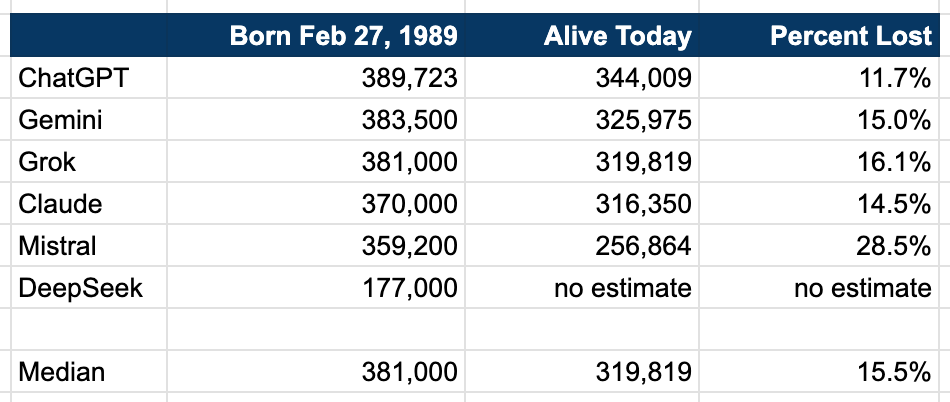
That puts our current community size at around the size of cities in the US like Irvine, CA or Newark, NJ or Cincinnati, OH. In Europe, cities of this size are Mannheim, DE or Bari, IT or Espoo, FI. In Asia, where most of our Dayborhood population would reside, comparable cities could be Dianjiang, Chongqing in China or Junagadh, Gujarat18 in India; cities in Asia tend to be so large that a city of this size probably wouldn’t be on your radar unless you live near it.
Put another way, assuming equal distribution of FoFTSNENians across cities -- an assumption that is almost certainly wrong but maybe close-ish -- for every 100,000 people in your city there would be 3.9 “daybors”. Jakarta metro area, recently declared the world’s largest city with 42 million people, would have 164 birthday-sharers. NYC’s 8.5 million would have ~332. The 500th largest city in size, Gorakhpur with roughly 1 million people, would have 39. So there is overlap in spatial and temporal proximities.
Still, there are many more questions I’d be interested in here:
What’s the population distribution of RoFTSNEN? What is our most populous city?
How are we doing on other key life goals? How are we doing in general?
Are Dayborhoods a truly random slice of the global population? What makes RoFTSNEN distinct?19
Perhaps future updates can dig into these questions. For now, I hope you appreciate this small brief update as my own birthday gift to you, fellow birthday-haver.
Please notify me if I’ve somehow missed that somebody else in our birthday-having community is already sending a newsletter like this, as I’m not looking to step on any toes. Truly, I don’t know of any other birthday community having a newsletter of this sort? But that can’t be the case, as creating a newsletter like this seems like such an obvious administrative act to take, right?
And so, even though there is much more to report on all the amazing work we’re all doing, I will wrap up for the night. There’s still a little time left in “Greater February 27th” -- the latter time zones still have daylight even! It has been and continues to be a delight to share this day with you all.
Yours in Birthday,
Harry Brisson
Miami Hospital, 4:25pm, February 27th, 1989
PS. Oh yeah, and Happy Birthday!20
I spent my 31st birthday on a train traveling across the island of Java in Indonesia, which is a few degrees south of the equator, but that doesn’t really count in my opinion. It’s roughly the same as the five birthdays I had in Singapore (13th, 14th, 15th, 16th & 17th); these were not seasonal birthdays in any conventional sense.
“The Galaxy Song” from Monty Python’s Meaning of Life that guides through the math, in case that’s helpful. The video has aspects that are not-safe-for-work (in a The Miracle of Life kind of way) but the audio alone is family friendly enough.
I’m honestly still trying to wrap my head around some of this math, and will probably try to diagram this out or something. It’s not intuitive to me at all.
The word “nation” comes from the Latin “nasci” for “to be born” -- so I’d argue it’s the nations that aren’t built on shared birthdays that are really the weird ones.
Yes, we would potentially share an acronym with the Republic of February Twenty-Sixth Nineteen Eighty-Nine, and yes, I find this annoying. But maybe they can choose to be a People’s Republic instead to give us the acronym to ourselves. Until they state their preferred name, I’ll just consider them the “Unincorporated Territory of…”, abbreviated as UToFTSNEN.
If you have a Facebook account, the birthday page on Facebook (“https://www.facebook.com/events/birthdays/”) should let you view “Recent Birthdays”. Many people don’t list the particular year, but you might find you know someone in our constituency!
You certainly don’t have to do this, though; it’s just an option if you like a more participatory newsletter experience.
Those Pacific Islands aren’t very populated, so I expect we don’t genuinely cover that full range, but it’s not too far off.
It’s possible that French footballer Loïc Poujol and Russian footballer Viktor Karpukhin should be on this list? The former has his Wikidata birthday stat listed as February 27th, 1989 but then his English Wikipedia biography claims it is September 27th, 1989? And the latter has a similar confusion, with the English biography stating December 27th, 1989 and Russian biography stating February 27th, 1989? So this is just a general “flag” on using Wikipedia so centrally in my analysis.
I also enjoyed the movie and how it suggested that when someone travels back and forth in time, it means that every child born between the starting and end point of the time-travel is genetically reconstituted, and with all the time travel in the film that would mean a lot of kids are kind of… killed? It’s a moral question raised and largely ignored, but really impacted my feelings during the film.
Arabelle Raphael’s birthday is contested -- her Spanish, Turkish and Farsi Wikipedia pages cite a birthday of February 27, 1989, but her English page is ambiguous and cites only 1988 and 1989? I’m defaulting to the majoritarian perspective here. But also, I should probably be more mindful of how discretion about age is important? I’m only repeating info that is online elsewhere, but if anyone asks I will certainly remove references to names!
Less “soul-crushing”, more just “crushing it”.
For anyone reading who doesn’t share my specific birthday, this SPARQL query on Wikidata lets you see a list of people who share a particular day of birth, ranked by number of pages. You just would need to change the date to your own birthday, and you could create your own assessment. I can probably create a simple tool to expedite this kind of analysis if people are interested in it.
None of my writing here uses AI though! I only use it as a research tool and to copy-edit! I’m big on humanistic communication, which is the rest of what I usually write about! (This “Dayborhood” concept, for example, is a way to contemplate my subset of the global population; it’s also a way to fight monoculture and connect with your own distinct subset of the world.)
Claude was the only Chatbot to wish me a happy birthday. Thanks, Claude. How can other bots be so sycophantic and yet miss these simple kindnesses?
DeepSeek has a “DeepThink” feature that is also not quite the same thing; I had to add “please provide your best estimate” to the end of the prompt for it to provide an estimate, and it struggled with this. That said, this was using the DeepSeek Chat, which does not run for nearly as long as the other chat services I used.
Grok doesn’t have a Deep Research capability as far as I can tell, but I used “Grok 4.20” which seems to be similar?
The India city population estimates on Wikipedia are 15 years old, so Junagadh is much larger now; it’s the closest I could find for now though.
And specifically, on what measures are we outperforming the clearly lesser community of UToFTSNEN? (See footnote 5.)
Or happy belated birthday, since I trust anyone who receives this with a February 27th birthday will have received it considerably after the fact.