


It’s that time of year for resolution-smithing, and as is my tradition I’m inviting you all, “my public”, to witness my reflection.
Since starting this tradition at the end of 2016, this is my tenth “end of year wrap-up”. It’s been four years since I made the pivot to sharing outside of my immediate professional community, blasting friends and family with an email in 2022 and 2023. And only in 2024 did I move this exercise completely onto Substack, which makes this my second Substack annual wrap-up.
Doing this on Substack means there are a couple of you who I don’t personally know, but hopefully you still find this connected to the Middling Content mission to support pro-human global media systems. And for those of you that are indeed friends and family members, know that I have greatly appreciated you keeping me in your reading list! I enjoy the texts you send my way, whether they are responding to an idea I’ve shared or asking when the next article will drop.
This year had more posts from me than ever before -- 13 total, averaging over one per month! And though I did not complete my “booksquare”, the number of words I published was over 66,000, which could be a short nonfiction book if my writing was more cohesive. I have thoughts on how I can better focus my writing in the new year, and hopefully that will create more interesting and useful content for readers like you. Expect a deeper debrief on this in January, but feel free to reach out to me if you have specific thoughts on how you think this newsletter could be more useful to you as you look to improve how media serves you and your goals.
For today’s reflection, I will do a bit of meta-reflecting. I’m big on traditions like this “end of year” newsletter, and I think it’s worthwhile to investigate how traditions can help or hamper our journeys to be our best selves.
Habit expert and guy-I-went-to-college-with James Clear defines a habit as “the small decisions you make and actions you perform every day”.1 Traditions tend to be more spread out and mindful, in part due to how they tend to be more temporally spaced out. Clear teaches how stacking and context can be used to make habits easier; with annual traditions, our lives change so much .
This raises the next question: With life so short, what if anything is worth repeating?
Here I think to the old Emerson line in Self-Reliance, “A foolish consistency is the hobgoblin of little minds.” I don’t think this end-of-year email is foolish, as it fits in what I see as the spirit of “Old Year’s Day”, the last day in a given year. But how can we articulate this spirit of the holiday? And why honor the changing of a timekeeper’s detail like the year at all?
Indeed, a good “Old Year’s Day” tradition serves a deeply noble human goal: protecting human life.
Surviving the Summit of Mount SAD
Between flu season, scarce daylight, intense gatherings and cultural pressure, many folks struggle this time of year. New Year’s Day serves as the peak of this difficult season, and indeed an analysis of over 57 million death certificates found that it is the peak of biological disorders overall. Sociologists Phillips, Barker and Brewer found that between 1979 and 2004, more death certificates were dated January 1st than any other calendar date.
Knowing this, it’s important to ask: How can traditions help people evade the most common traps of this deadliest day of the year?
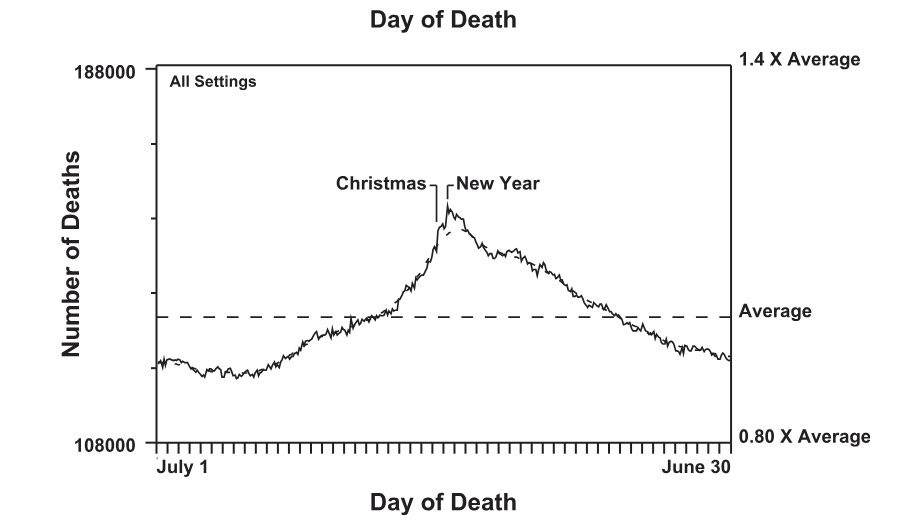
I like to picture the average dotted-line as where the snow starts on the mountain.
The researchers found a variety of causes and explanations, though they focused more on the spike in deaths on Christmas that is observed in emergency rooms. The authors connect this with staffing issues, people postponing treatments to be home for the holidays, drugs and alcohol usage and also travel-related deaths.
But the New Year’s Day story is a bit different. Digging deeper into this requires another paper and a trigger warning, because a major driver of death on New Year’s Day is as tragic as it is often preventable: suicide. A group of researchers with Multi-City Multi-Country (MCC) Collaborative Research Network published an analysis in 2024 that found rates of death due to suicide could double on New Year’s Day in some regions, making this likely a large contributor to the 2010 death certificate analysis.
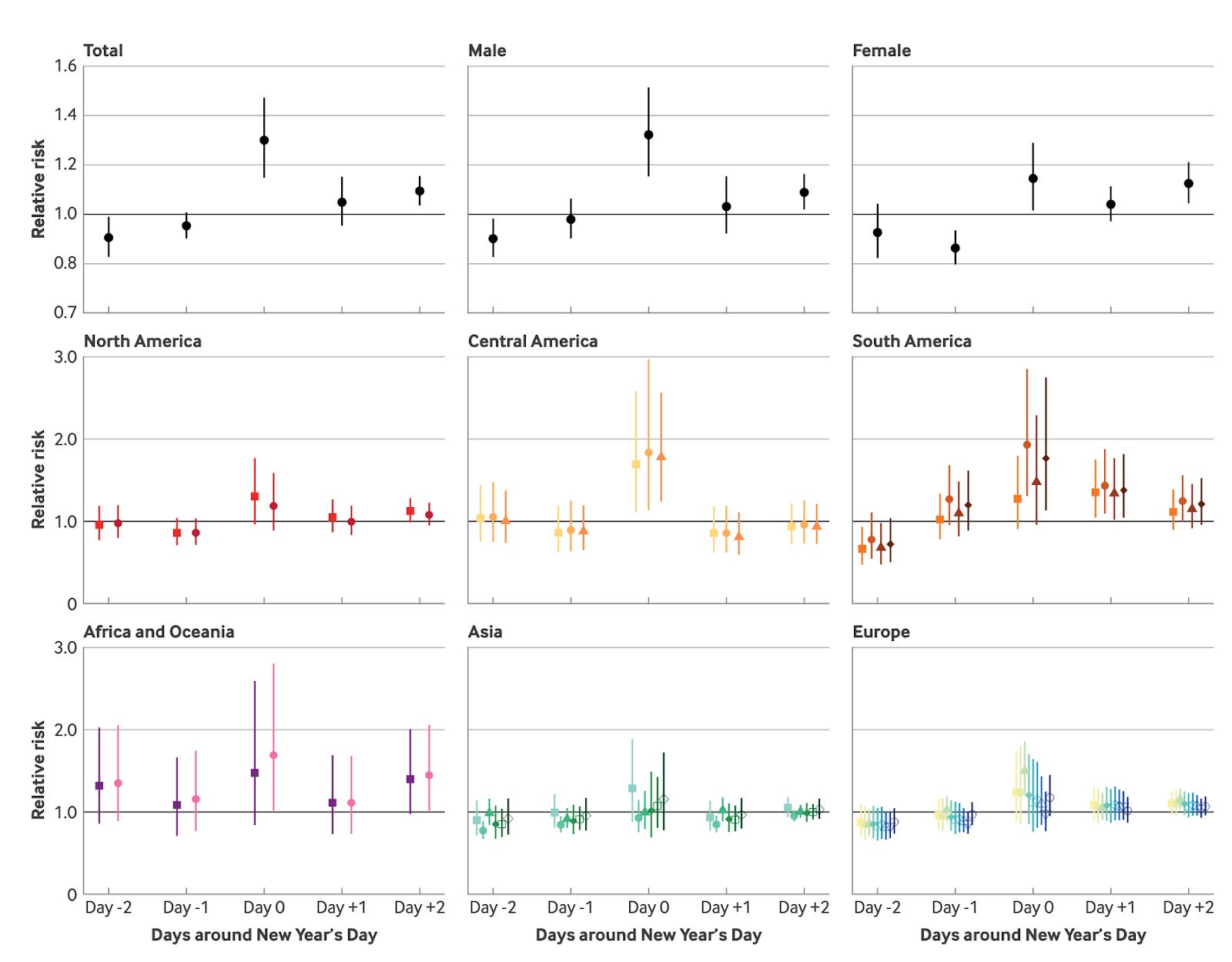
The researchers specifically cite a few possible explanations:
the “economic activity cycle”, with victims struggling to readjust to work after vacation
“broken-promise effect theory”, driven by clash in new year expectations and reality
alcohol use that is particularly heavy on New Year’s Eve
the shift from a high socialization season to a relatively isolated season
Based on this, a healthy and safe New Year’s Eve & New Year’s Day is nourishing, balanced, dry and connected. And if you want to incorporate the broader health risks into the season, it doesn’t hurt to keep close to your regular sleep schedule. (I’m going to bed right after sending this, personally.)
A supportive tradition that is nourishing, balanced, dry and connected helps curb the risks associated with the holiday while also hopefully providing you additional benefits. This newsletter hits all four notes for me: (1) it nourishes me by aligning with my passions for reflection and analysis, (2) it is balanced in realistically assessing the past year, good and bad without setting unachievable expectations, (3) it is alcohol-free and (4) it helps me feel connected with people who matter to me -- you all!
Slightly rephrased to map to an acronym: a good tradition is Realistic, Interconnected, Sober and Enjoyable. My newsletter tradition helps me RISE to meet the new year, even in tough times. (And tough times are the times when I need it most.)
If you are trying to survive the summit of Mount SAD this year, you might also benefit from traditions that target the exhaustion, disappointment, intoxication and loneliness that can make New Year’s Day so hard. With some slight rearrangement of these nouns, you can remember the acronym IDLE: you don’t want to be IDLE on this holiday unless you absolutely have to be. This could mean creating new traditions that keep you nourished/balanced/dry/connected. And if you have traditions, as I do, you may benefit from reflecting on how well they suit the shape of the holiday.
So to demonstrate this, I’m using my Old Year’s Day newsletter to investigate 3 of my consistencies! I think two consistencies prove themselves to be healthy life-affirming traditions. But in one case, my investigation did turn up a hobgoblin.
And at precisely midnight tonight, that hobgoblin will be eliminated.
Consistency #1: 19 Haircuts
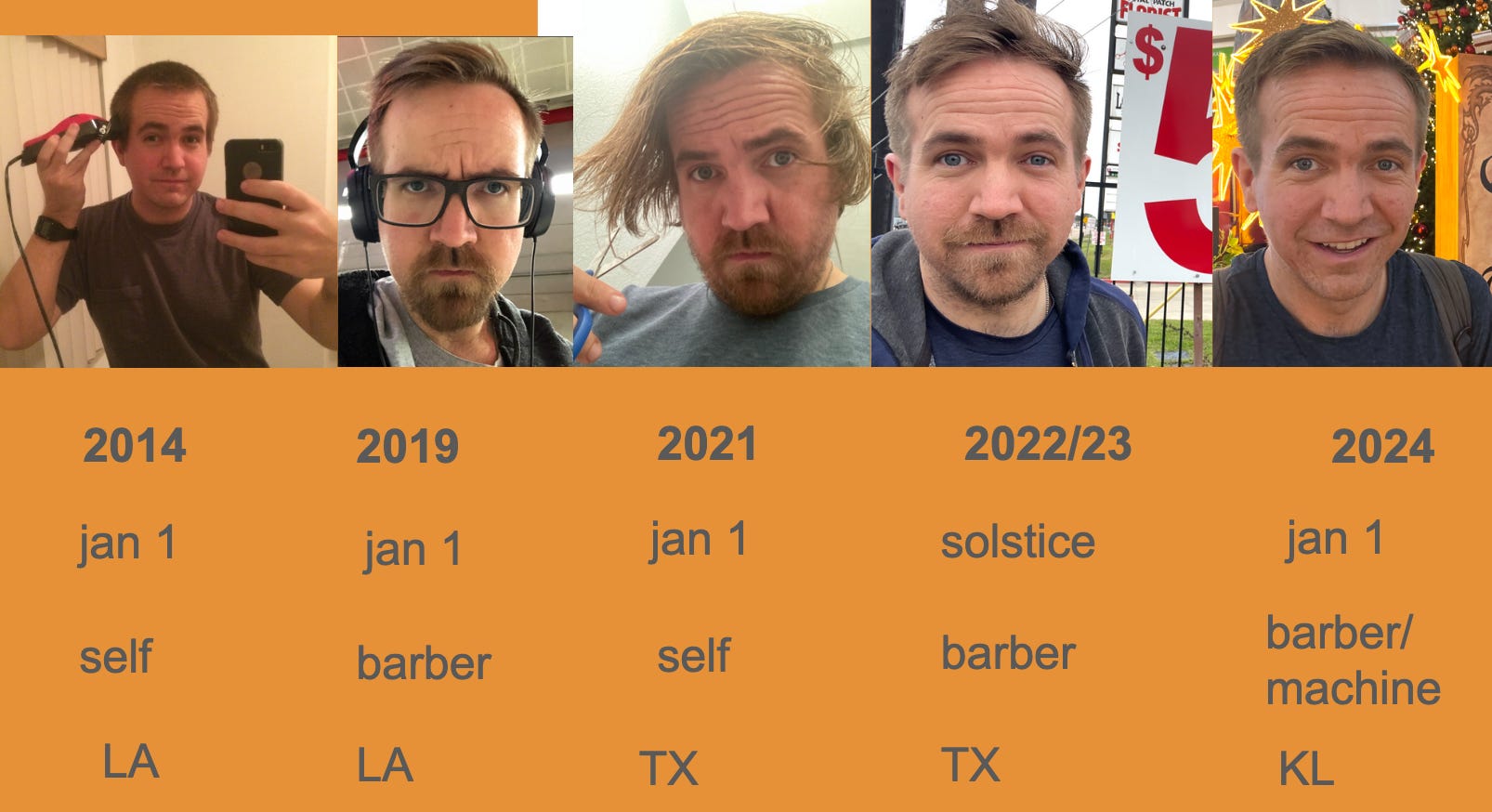
My oldest tradition is “New Year, New Haircut”, which turned 19 this year. This means I’ve honored “New Year, New Haircut” for over half of the years in my life. It is time-honored -- but that doesn’t mean it isn’t still secretly a hobgoblin!
Let’s work through the RISE / IDLE2 framework.
Realistic / Disappointing:
This is perhaps a point of danger. We have grand expectations from our haircuts, but they are notorious for throwing curveballs. The newer and more ambitious the haircut, the higher. Assessment: Some Risk of Disappointment.
Interconnected / Lonely:
Not in itself a social experience, though having a fresh haircut can motivate socializing. The pseudo-social conversation with the barber can certainly go poorly, and the wrong questions about the holidays or life can get your mind focused on unhelpful thoughts. This requires modification. Assessment: Some Risk of Loneliness.
Sober / Intoxicated:
I’ve never had a “NYNH” under the influence, and a drunk haircut sounds honestly nightmarish. Assessment: Sobriety Assured.
Enjoyable / Exhausting:
For cities that I knew well or cities abroad, I could usually find a place that is open. In Katy, TX -- long our family headquarters in my college and early career years -- I would get my hair cut for $3 (plus a generous New Year’s tip) at a nearby Vietnamese barber, and in NYC there would be barbers open in Chinatown. In many cities, though, finding a haircut place that is open on New Year’s Day is very exhausting, so this too pushes toward modification. Assessment: Some Risk of Exhaustion.
Because this tradition has been around for me for two decades, I’ve made adjustments to make it more manageable. Specifically, I allow myself to get my “New Year, New Haircut” haircuts on the Solstice instead of New Year’s Day proper. This both reduces the exhausting logistical requirements and makes it easier to find a barber I feel more confident in, plus even if things go a bit sideways I am not forced to confront a bad haircut on an already emotionally strained New Year’s Day.
Verdict: Some of these haircuts were foolish, but the post-modification tradition itself succeeds at creating a sense of hope and possibility for the year ahead. It will not face execution this year. After thorough Emersonian investigation, it is deemed: “not a hobgoblin”.3
Consistency #2: 15 Whenvelopes
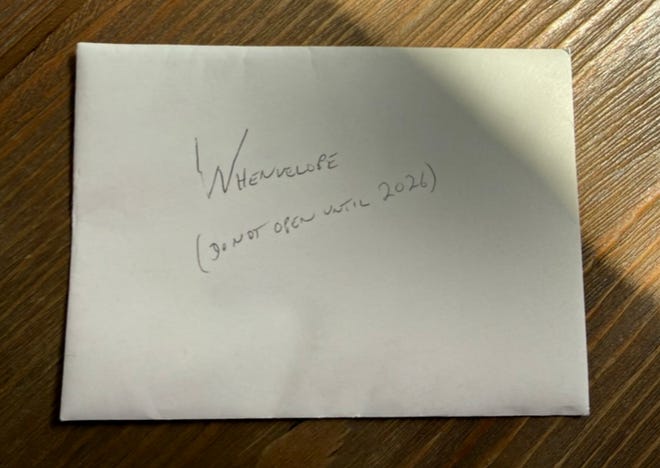
This newsletter is actually just one piece of correspondence that I have in my Old Year’s Day tradition. I also write my “future self” a letter each Old Year’s Day (AKA Dec 31st) and then on New Year’s Day I will read my letter from a-year-and-a-day prior. I place the letters in a “Whenvelope”4 and I only allow myself to open the Whenvelope on January 1st.
Again, we can work through the RISE / IDLE framework.
Realistic / Disappointing:
My personal reflection, even more than what I share in my newsletter, is deeply realistic. I cover both highlights and challenges of my past year, but I also don’t over-sell my future self on what the new year might bring. After all, I don’t have any idea what the circumstances of my future self will be; they could be great, but they also could be pretty terrible. So much can happen in a year. Perhaps due to my disposition, I’ve never had a challenge keeping my letter grounded. Assessment: Highly Realistic.
Interconnected / Lonely:
This is a solitary activity for me, and it’s one that on rare occasions has pulled me away from real human-to-human interaction, but overall I’ve found receiving a letter from my past self on New Year’s Day to feel genuinely pleasant. I think as a young person I had a pretty bad relationship with myself, and even today I can have unhelpful self-talk. But these Whenvelope letters are special to me, and I’m always deliberate to write in such a way that makes my future self feel loved. I don’t think anyone should be their own only friend, but being a good friend to yourself is important, and it’s most important on a New Year’s Day in a tough season. With the Whenvelope, I know I’ll never spend a New Year’s Day alone. Assessment: Combats Loneliness.
Sober / Intoxicated:
I have probably had a drink before writing my letter to myself, but never in excess. Because I take the exercise seriously, it gives me a reason to keep myself lucid and effective. It’s more likely to reduce my drinking than increase it. Assessment: Not Inherently Intoxicating.
Enjoyable / Exhausting:
I have found that balancing both my newsletter and my Whenvelope is sometimes too much of a burden for a single day, which is why I sent my end-of-year email out on the Winter Solstice the last two years. I was running behind this year, and that created a little undue pressure. But it’s manageable, and I’ll try to better separate these next year. Assessment: Some Risk of Exhaustion.
I will note also, though, there is additional upside with the Whenvelope exercise in that it provides me with my own brief summary of what I’m working through each year. I can see that the past 15 years break into roughly three chunks: (1) figuring out how to contribute to the world with research from 2011 to 2015, (2) being drawn to research with greater social impact from 2016 to 2020 and (3) experimenting with a more independent work arrangement from 2021 through now. And looking at the overall range of letters, I can see I’ve had many tough years: specifically in 2011, 2013, 2014, 2020, 2022 and 2023. This also helps me see, though, that through focus and effort, I’ve been able to find my way to success.
Verdict: The name “whenvelope” is a bit foolish, but the tradition is purposeful and healthy. It will survive into the new year. After thorough Emersonian investigation, it is deemed: “not a hobgoblin”.
Consistency #3: 2117 Days of Duolingo
My streak with Duolingo is shorter than the other traditions I’ve mentioned, mapping to roughly 5.8 years, but this is still a long time.
It’s longer than I’ve lived in any particular dwelling (five-and-a-half non-consecutive years in an East Hollywood apartment) and nearly as long as I’ve lived in my longest-lived-in city (Los Angeles for six-and-a-half years). It’s also longer than any romantic relationship I’ve had. (Considerably so.) So it’s with a heavy heart that I consider: do I need to break up with Duolingo? That is: is Duolingo a hobgoblin?
Duolingo as an app changed a lot over the past six years that I used it. I started using it when I started “decentralizing” my life in 2019. Many of these changes were good: new reading exercises, interactive games, more lifelike voices, the vocab card-matching. Some of them, though, seemed close to what designers call “dark patterns”, with gambling-machine style engagement mechanisms. While I still admire a lot of Duolingo’s mission when it comes to providing low-cost language credentials for non-native English speakers, as an app user who has also dabbled in creating his own language-learning applications, I don’t feel it’s the right way for me to be spending my time anymore.
I don’t feel the need to break out by the RISE / IDLE framework. Let’s jump to the verdict.
Verdict: Duolingo has stopped being enjoyable and instead has become exhausting. Rather than making me feel meaningfully interconnected to friends, it exploits my relationships with them, holding them hostage and demanding my increased usage. Vibrations and sounds and in-game currency make it less sobering and more a cheap hack of my dopamine systems. After thorough Emersonian investigation, it is deemed: “a hobgoblin”! OoooooOOOOooooo!
Sentencing: I last completed a lesson on Monday, and I used up a “streak freeze” yesterday. And so the good people of Times Square will be counting down to the moment my streak will elapse and be no more. Add it to the January 1st heap of casualties. Hobgoblin handled.
I do want to add that this is all actually quite difficult to contemplate. Having a 2k+ streak has been a source of pride for me, but that pride is the exact kind of foolishness that hobgoblin-hunting is designed to reveal and address. I left two jobs this year, and even though I know those were both the right decisions, parting ways was still tremendously difficult. I also wrote about leaving the Intuit ecosystem earlier this year, and though I was flippant about the departure that too was a little frightening.

There is more to note in this exercise, though, so I will add another assessment: this time evaluating the overall act of “hobgoblin-hunting”. Might this be a worthwhile way to spend the early days of the new year?
It seems to me such a tradition (1) is grounded in realism, (2) has potential upside for interconnectedness if hunted hobgoblins were interfering with human relationships, (3) does not require drugs or alcohol and (4) can be energy-conserving in the long run. Maybe it’s less a “New Year’s Day” tradition than it could be a broader “early-in-the-year” tradition.
Bonus Meta-Verdict: After a tough year, it can be a good practice to allow yourself to break with old inertias. So a tradition of parting ways with software that increasingly deviates from your own interests is life-affirming. Hobgoblin-hunting in itself is a healthy Old Year’s Day tradition, and thus deemed: “not a hobgoblin”. (Though it’s also “not a consistency” either yet, so perhaps I’ll revisit this next year; I’m sure there will be new applications and brands trying to pull the rug from under me, and I must maintain my vigilance.)
Where To Next
You may find it useful to conduct a similar analysis of your traditions, but I’ll leave that to you depending on if you feel in need of making this season more bearable. Perhaps you are harboring hobgoblins? Now you can assess your individual traditions or habits to see if they help you RISE to meet the new year (by being Realistic, Interconnecting, Sober and Enjoyable) or if they are keeping you IDLE and unhappy (weighed down with Intoxication, Disappointment, Loneliness and Exhaustion).
As for me, I’m not done with my post-2025 reflecting. The time-scale with which we shift from the holiday season to “the new year” is brutally fast in the US, and it’s actually unusual that we structure it this way. Lunar New Year celebrations, honored in the vast Sinosphere, provide a 15-day festival that is less jarring. Even in the West, much of Christendom continues festivities into the new year rather than just dumping people in the future with nothing to look forward to until… Presidents’ Day? MLK Day?
Further, January first has only served as New Year’s Day in the Anglosphere for fewer than 300 years. Even January itself is only about 2700 years old. The Romans traditionally considered winter a monthless period, and the new year wouldn’t start until March when the Roman Consul would begin session.
So if you find yourself struggling, just say to yourself: “There’s no such thing as January. It was invented around 713 BC and it can’t hurt me unless I let it.” More on that in the coming weeks. For now, I’m just sending love as we all do our best to survive the deadliest day of the year. (And getting some rest to prepare for the year ahead.)
You’ll hear from me again in the post-December pre-March un-monthed winter! I’ll share more about the shift to the modern abrupt switch from a more graceful inter-annual cross-fade. The old more humanistic calendar is still there for us, and embracing it might even save lives.
Until Then,
With Much Love,
Thanks for Reading,
Harry
I have seen Atomic Habits promoted heavily on every continent, and I am comforted by the certainty that no matter how many people I can get to read it will be a drop in the ocean that is Atomic Habits fan culture. I’ll sometimes joke that if you’re going to read a book by a guy who went to my college, you should read A Million Little Pieces; that said, I genuinely found Atomic Habits to be a remarkably well-architected value-focused book -- one that is framework-centered which makes it as-or-more useful if you only consume it through a YouTube gloss. It’s part of the inspiration for my own “booksquare”.
Unfortunately the acronyms don’t quite map to each other. Something I can resolve to improve next year maybe.
While people can find a “hope-building” tradition tempting for the new year, as I once did, attempts of drastic self-intervention are actually quite dangerous. I recall reading up on LASIK suicides before getting LASIK to improve my vision. Even though LASIK improved my life considerably, people have the tendency to overstate. (And LASIK marketing can push people too hard to envision an ideal post-LASIK future.) Manage your expectations and limit the possible downside. I’d probably be better off letting myself buy some new shoes or clothes instead of going for a haircut.
An envelope with “Whenvelope” written on it.
Much respect for your decision to mindfully step away from the Duolingo streak.