

On Radio, Fitspo, BBC Igbo & Bombardilo
Introducing "The Good, The Bad and The Monthly": a new email digest guide covering the latest research on how the media can help and hurt you.

I’ve counted at least 4,774 papers about how the media impacts wellbeing last year. How many did you read? How many did you hear about secondhand?1
It’s hard to keep track of all the research that gets published, and I myself haven’t followed as closely as I’d like to. I’ve written about how media incentives aren’t always aligned with the interests of audiences, and science journalism is one of the clearest examples of this.

This challenge is downstream of three other challenges:
Reading Papers Is Time-Consuming
Assessing Papers Requires Expertise
There Are Lots and Lots of Papers
Last year, I created a system to track papers published related to my particular focus on media and wellbeing, and I’m hoping to utilize this to help non-specialists (with still some level of quantitative background) follow what’s going on in the research literature. And by covering both media harm risks and healthy media opportunities, my goal is to avoid the clickbait doomscroll aesthetic of other newsletters.
Since my personal new-year-to-new-birthday interregnum has elapsed, I’m going to apply some of my own reflections to make Middling Content better. This will be a monthly newsletter that tries to help you understand what might be good and what might be bad in the world of media.
A few values are going to guide this project:
Focus: I think the newsletter last year had become a bit sprawling, and I’d like to have a core that helps me build toward a specific objective. I may still have a long-form post every once-in-a-while, but this monthly structure will give a more stable architecture.
Community: Whereas the newsletter was mostly pushing my own ideas and reflections in 2025, I also would like to help connect scholars studying this space with each other.
Usefulness: While maintaining more of a reflective travelogue has been fun, it’s more obvious how a digest like this can help people make everyday choices about how to interact with various media tools -- and even to design their own media tools as AI empowers more direct management of our media and information pipelines.
And thus I’m introducing “The Good, The Bad and The Monthly”: a breakdown of recent academic articles on media and wellbeing that attempts to distill all these insights into something actionable. I hope to keep this running through the year at least, and if people find it useful or interesting I can continue it further beyond that.
Some extra on methodology since this is the first post, but feel free to skip ahead to “What’s Good”, where I talk about findings that affirm media doing good in the world. (Or just skip ahead to the “Media Impact on Wellbeing…” biplot if you’d like!)
How to Boil the Ocean
There’s a lot of sloppy thinking on what media is good and bad. It’s fun to be sloppy sometimes, but it’s important to occasionally be non-sloppy too.23 (Often, even.) So I’ve created a four-stage pipeline that I’m using to process papers on media and wellbeing: find, filter, finesse & assess.
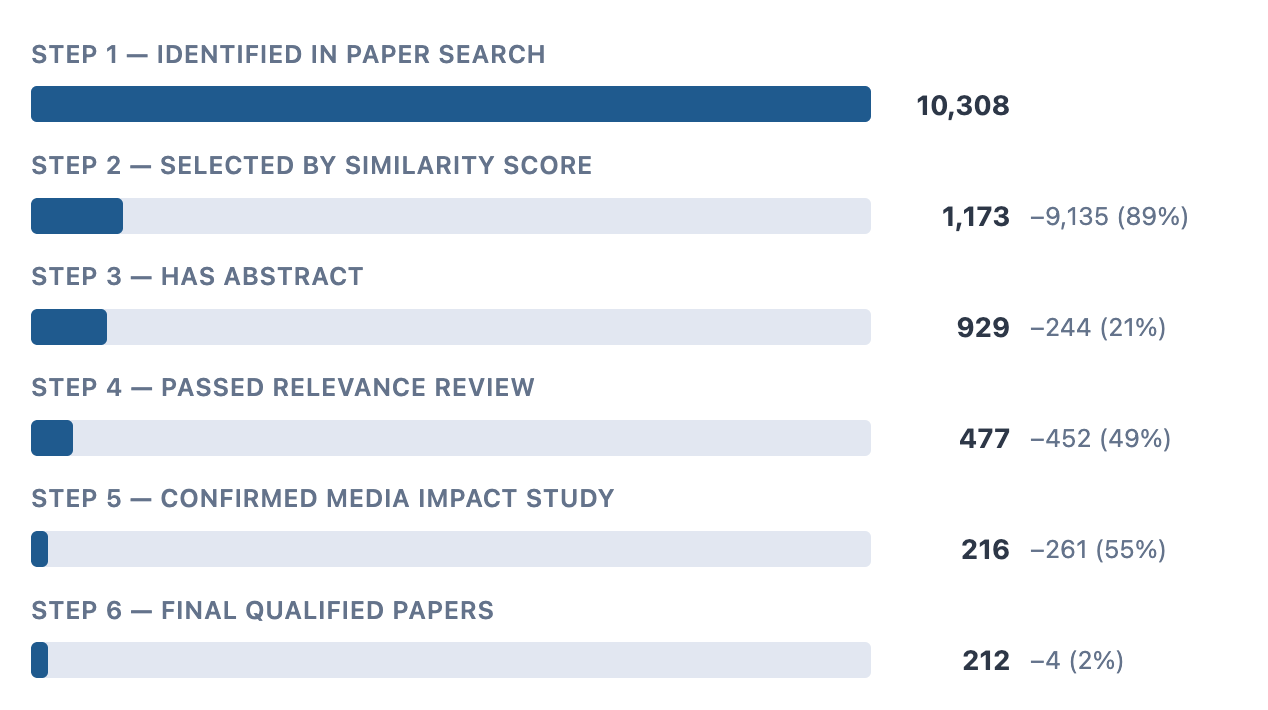
Here’s what that can look like.
Find. Each week I query Semantic Scholar identifying papers that relate to both “media” and “wellbeing”.
Filter. Calculating semantic distance toward both “media” and “wellbeing” as topics within the papers. (See my essay on “Law & Quoter” for an explanation of semantic distance as a concept, particularly the section on Wordspace.) Top 200 papers with abstracts progress to the next round.
Finesse. First, a chat completion review to confirm that both “wellbeing” and “media” are explored in the publication, and at least one of the two is central to its research question and conclusions. Then, a second chat completion review to confirm that the paper specifically looks at media impacting wellbeing.
Assess. A LLM-supported style transfer into structured data, identifying if and how each article observes a specific media type’s impact on wellbeing. Impacts are further quantified in a synthetic maxdiff exercise to estimate relative valence of impacts.
Ultimately, the exercise produces a dataset of media types and their evaluated impact on wellbeing.
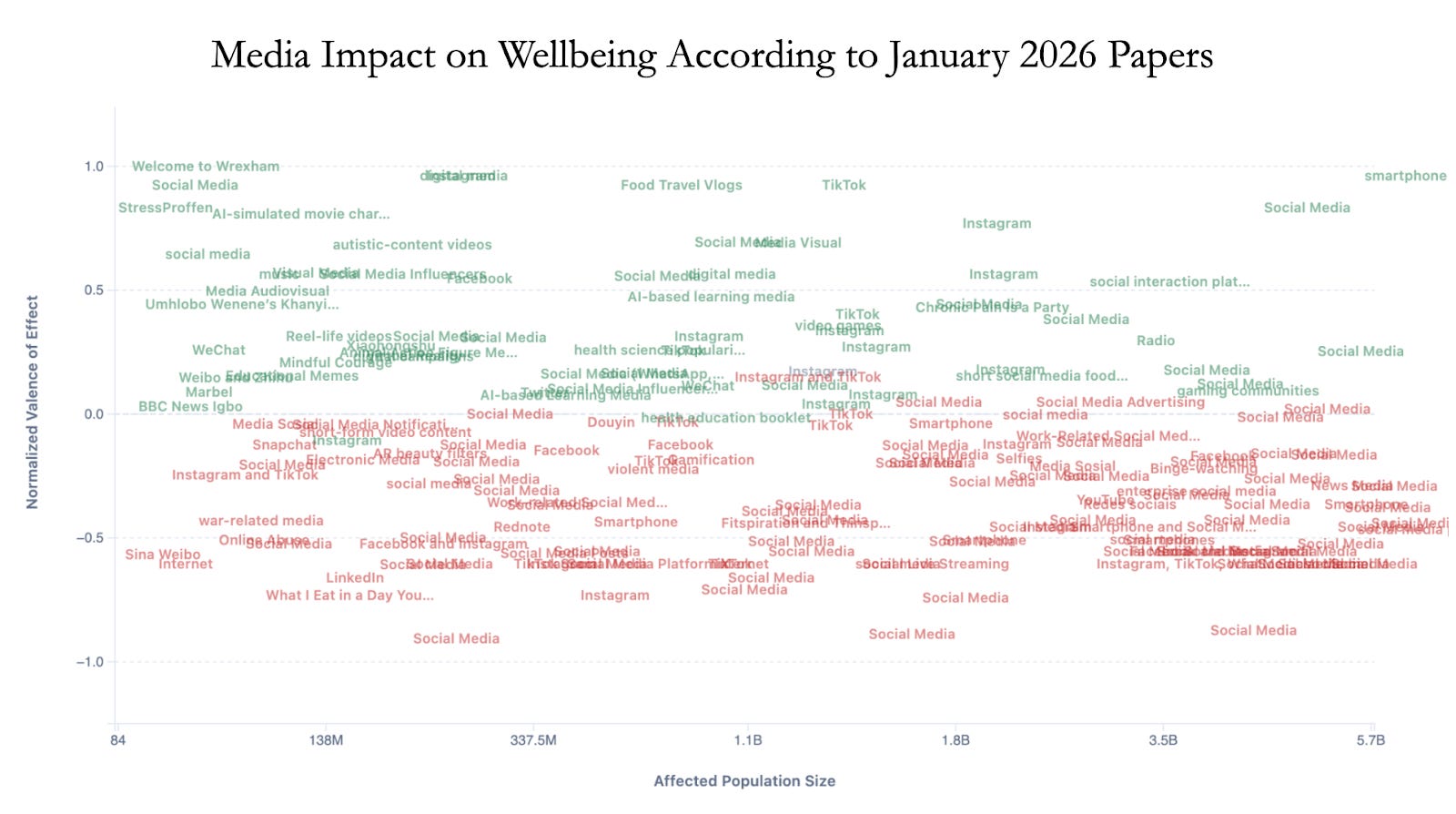
From here, I can pick a few particular papers to highlight.
Let’s take a stab at this to show what that could look like!
What’s Good?
Researchers Jan Boehmer and Kyriaki Kaplanidou calculated that the TV program Welcome to Wrexham increased employment, per capita GDP and mental health within the city of Wrexham, Wales. (Full paper: Did Deadpool Save a City? The Social and Economic Impact of “Welcome to Wrexham”.)
An experimental study conducted by researchers at Lafayette College and the Economic and Social Research Foundation in Tanzania found listening to 90-second radio dramas nearly doubled willingness to report intimate partner violence. (Full paper: The effect of radio dramas on willingness to report intimate partner violence.)
Researchers at the School of Social and Behavioral Sciences in Nanjing University found that playing video games with nature settings increased the likelihood of donations to environmental causes and support for pro-environmental policy. (Full paper: Techno-Biophilia Design in Video Games and Its Positive Social Outcomes.)
Researchers Fiona Chalk and Chillonda Agyeman found that music can reduce reliance on medication for dementia patients. (Full paper: The role of music in supporting people with dementia in acute hospitals.)
Interviews conducted by Ikechukwu Williams Eke and Abiodun Salawu found that BBC News Igbo increased prestige and pride associated with the language of Igbo in Nigeria. (Full paper: Impact of digital media on language revitalization: the case of BBC News Igbo.)
Cici Situmorang, Lia Amalia Ramadhani, Iqna Nur Fadilah and Raffa Fahdiaz Romadhon at Institut Prima Bangsa attributed increased learning motivation and decreased anxiety in educational environments to the Sabrina Carpenter “Nobody’s Son” music video.4 (Full paper: “Meningkatkan penguasaan kosakata Bahasa Inggris melalui video lagu Nobody’s son”)
Food vlogging content was found to increase “cultural curiosity” and visiting intention by researchers Md. Salamun Rashidin, Babak Taheri, Giacomo Del Chiappa and Sara Javed. (Full paper: From cultural curiosity to culinary sustainability: how social food reels foster food culture preservation.)
What’s Bad?
On the other hand, researchers at University of Pennsylvania and University of Delaware found that viewers were more likely to eat a cookie instead of an apple after watching food vlogging content that includes sponsorships. (Full paper: Your media diet is impacting your actual diet: The effects of influencer “What I Eat in a Day” YouTube videos on influencer perceptions and nutrition behaviors.)
A literature review from Ibrahim Taylan Dortyol, Merve Nalbant, and Asli Guven at Akdeniz University explored all the various ways that selfies impact body image. It’s paywalled but I’ll go halfsies with anyone interested. (Full paper: Selfie Behaviours and Body Image Concerns: A Systematic Literature Review and Future Research Directions.)
Xiaofan Yue and Xin Cui at Huangshan University found that “emotion enhancement motives” toward binge-watching makes addiction more likely. (Full paper: Binge-watching addiction as an emotion regulation way of coping loneliness.)
Researchers at Ramathibodi Hospital, Siriraj Hospital and the Institute of Child and Adolescent Mental Health in Bangkok, Thailand found that watching short-form videos about parenting was correlated with lower scores on evaluations of parenting knowledge -- whereas reading online materials was correlated with higher scores.5 (Full paper: The Association Between Media Use for Parenting Information (MUPI) and Parenting Knowledge, Attitudes and Practices Among Parents of Children Aged 6-19 Years.)
Kristine Schönhals, Christopher Lalk and Silja Vocks at Osnabrück University found that “fitspo” and “thinspo” content -- content that glamorizes fit or thin body types -- decreased happiness and body appreciation while increasing body dissatisfaction. (Full paper: Fitspiration, Thinspiration, Body Positivity, and Body Neutrality Contents on Image-Based Social Media: Associations With Body Image, Mood, Self-Esteem, and Disordered Eating Behavior in Women With and Without Self-Reported Eating Disorders-An Ecological Momentary Assessment Study.)
Researchers at Universitas Tarumanagara surveyed Gen Z LinkedIn users and found that more focus on maintaining their digital identity was correlated with more feelings of “social comparison”, which can be correlated with anxiety or insecurity. (Full paper: MODERASI KEBIJAKSANAAN DALAM HUBUNGAN IDENTITAS DIGITAL DAN PERBANDINGAN SOSIAL PADA GENERASI Z PENGGUNA LINKEDIN.)
Researcher Dhelittya Finaliyani Putri and the Islamic Communication and Broadcasting Department examines Italian brainrot and speculates on how it may impair concentration of students.6 (Full paper: “Fenomena Anomali Konten Digital dan Dampaknya terhadap Anak-anak”.)
And of course there were 124 papers on the impact of social media -- the majority of them finding negative effects and correlations, with 34 seeing positive effects and 89 seeing negative effects.
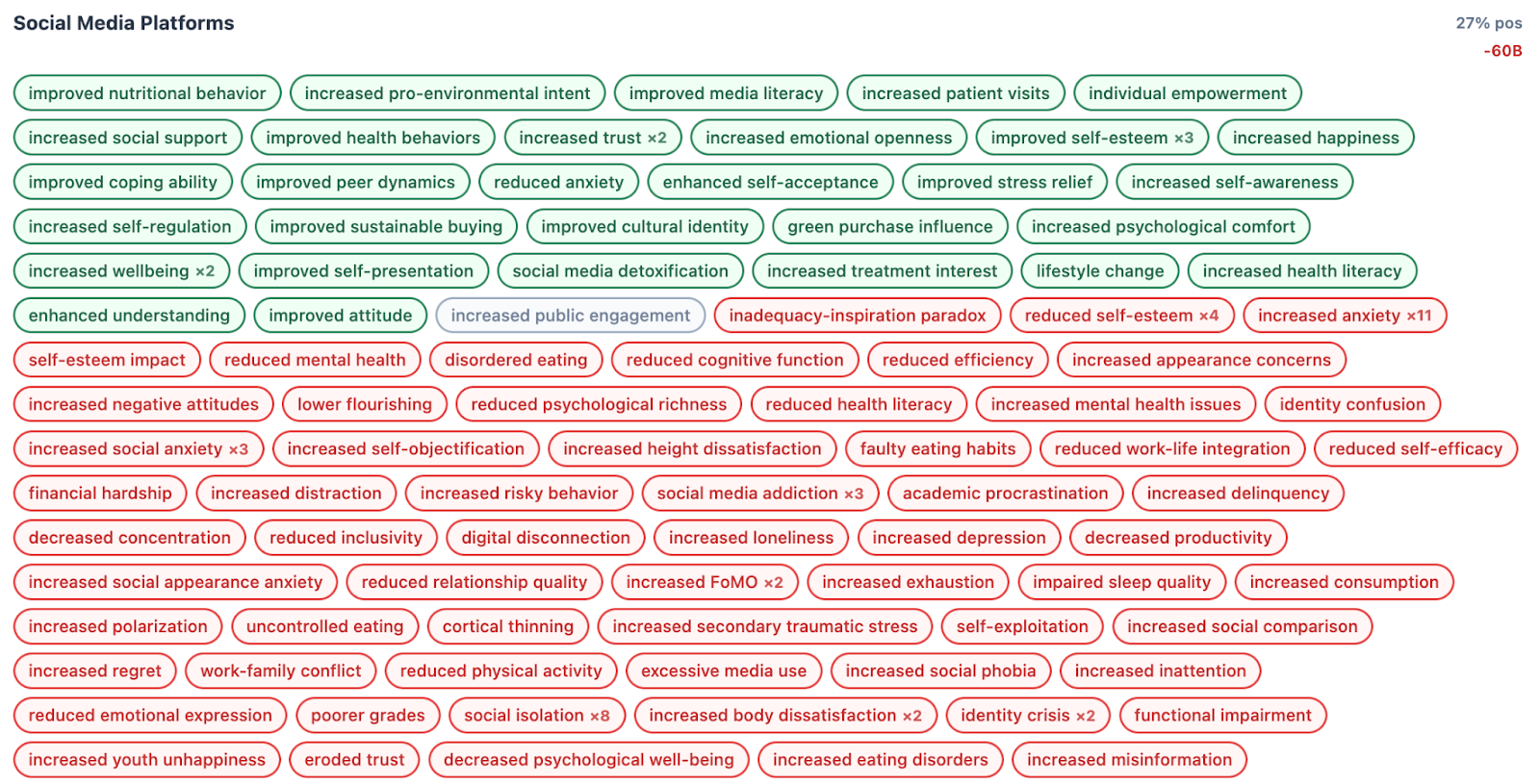
I need a dedicated methodology just to think about the social media research, to be honest. I don’t really have that yet. I’m working on it.
What’s Next?
This is a first pass, and since I have this constructed as a data pipeline it’ll be easier to build on this in future months.
I think there are three main areas I can continue to improve.
Timeliness. It’s March and I’m writing about January! It does take a little time for academic articles to be uploaded to source databases, so I’m okay with leaving a little time between “end-of-month” and the next post, but I’m hoping to be closer to “a week or two after the month ends” for my publication cadence.
Density. I think I’m losing too much value in the distillation process, and I would like to increase coverage of agentic-filtering and have a better measure of “methodology quality” -- differentiating pure experiments from natural experiments from correlational analysis, weighing concerns about external or internal validity, contemplating sample sizes.
Accessibility. I’ve been told that some of you find it easier to listen to a podcast than to read a newsletter, and so I’m trying to figure out if I can use a different format. I also am trying to incorporate more visuals and scorecards.
As always, I’m open to your thoughts on how a breakdown of a month’s worth of research can be valuable to you; if you like or dislike a certain approach, please let me know!
Thanks for following this journey as always!
Stay attuned!
Harry
Reading tweets that summarize clickbait that rehash misunderstood press releases of low confidence research findings? It’s better than nothing, possibly!
And ideally through iterations, I’ll become progressively less sloppy!
Also: writing the word “sloppy” so many times has reminded me of its connection to AI slop. Sloppy content is new, but sloppy thinking is as old as time. It’s just that AI lets us share sloppy thinking so much faster!
The effect seems to be for learning English in particular, but if you’re trying to learn something maybe give it a listen and see if it helps.
I could see the causality working in reverse here, but the fact that the effect is flipped for text consumption gives me some pause.
I like how the paper about Sabrina Carpenter and the paper about Italian brainrot complement each other. Some songs encourage educational development, and others wreck them. It’s unclear how many times you’d have to listen to “Nobody’s Son” to counteract the mental impairment caused by “Tung Tung Tung Sahur”. These papers aren’t particularly quantitative, and the subject matter feels a bit “moral panic”-y, but hopefully we see more development in this corner of academia. We need data on this.