

Three Words for May Day
Reflections on a few concepts that stuck with me since visiting most of the hometowns of the Haymarket Eight.

Happy May Day, Friends!
Last year I set an ambitious goal to recap the history of May Day in a newsletter -- covering not just the Haymarket Affair but also a prelude and extended coda. It ended up taking months more than I expected (and being much more content than I expected), but maybe for this 140th anniversary of the original May Day March you might enjoy scrolling through some of the pictures.1

This year, in hopes of publishing on time, I’m focusing on just three words!
But first: some brief context!
Some Words Before The Words
I’ve been thinking about May Day ever since writing last year’s piece. Even if I myself could stop, the world seems intent on constantly reminding me of its existence. Through sheer happenstance, two hotels I stayed at in the past year were immediately adjacent to references to May Day.

In Xi’an, I was staying at a central-ish Novotel2 near one of the old drum towers3, and it turns out that across the street is a “May First Hotel”. In Mexico City, a hotel I picked mainly for its proximity to a laundromat4 turned out to be right off of a “May First Avenue”. Two of my favorite cities5 on different sides of the planet seemed to be calling out to me: “your 22,713-word essay on May Day wasn’t enough, you need to write more!” And so here I am.
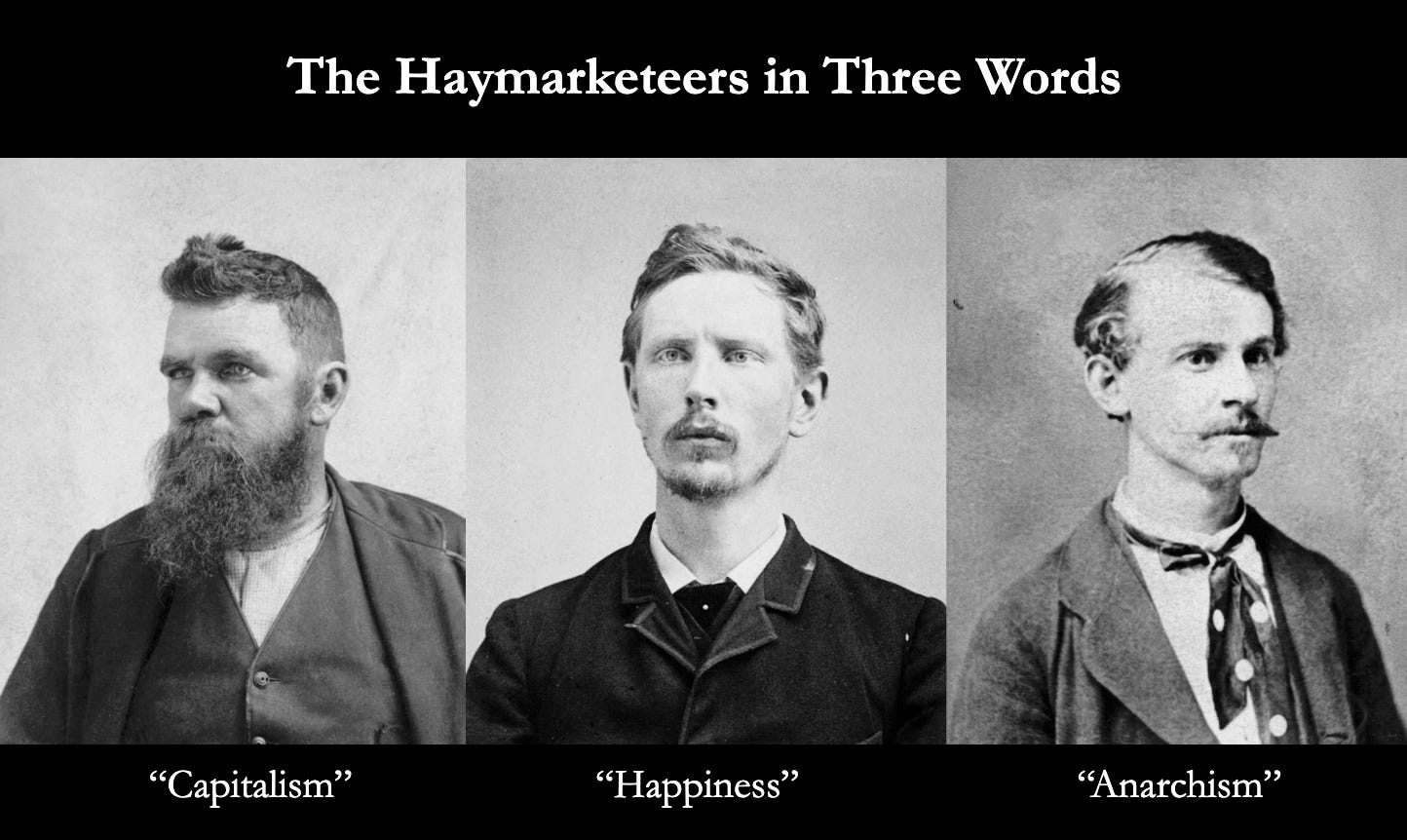
So I’m going to focus on three particular words to make three points.
The Haymarket Martyrs Were, In Some Regards, “Capitalists”
Many Could Benefit from the Haymarket Sense of “Happiness”
The Upside of a More Milquetoast “Anarchism”
And I’m going to limit myself to 500 words per point.6 The most important lesson that dead men teach us is that time is precious.
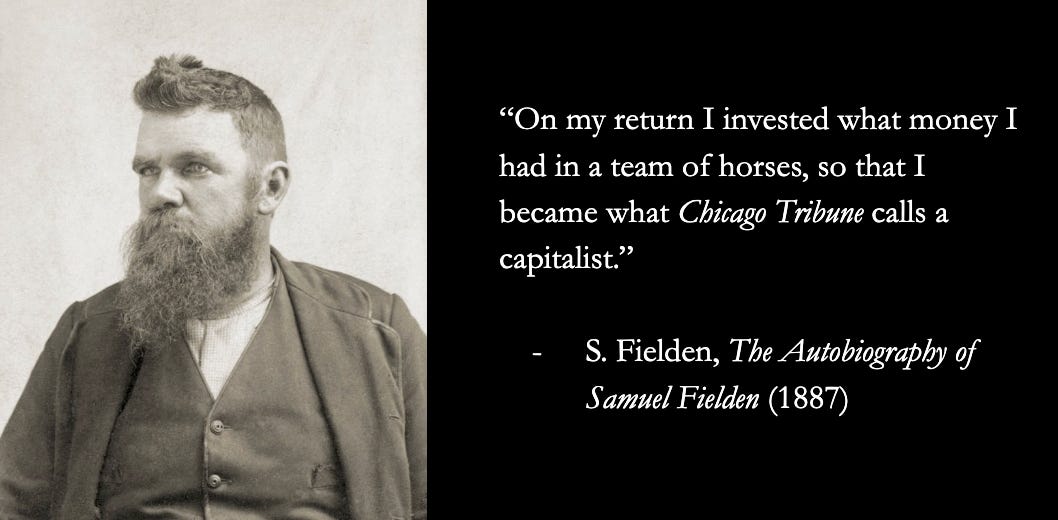
Fieldenian Capitalism
As mentioned last year, my favorite artifact in the Haymarket Affair Digital Collection (or “the HADC”) is the articles of formation “The Anarchist Publishing Association”. Essentially, the defendants established a company to take ownership of their case-related intellectual property -- the speeches given at the Haymarket and those given in their defense trial. They each got ten “capital shares” in the established corporation.7 Does it get more capitalist than this? What do we make of this? Did they… sell out?
I obviously don’t think so, but there is nuance here that shallower discourse can miss. The Haymarket Eight were critics of a system where power and private ownership went unchecked. But that isn’t the same as opposing the core principles of personal ownership and voluntary association. Effectively, in founding their media startup, they found a way to operate both within their ethical principles as well as within their broader sociopolitical context.
So, what is a “capitalist”?
Even Fielden, the most moderate of the eight, only ironically refers to himself as a capitalist in his autobiography, so I don’t want to suggest they embraced this label. The term “capitalism” is used differently by different actors; this IMF explainer focuses on the general unregulated ownership and control of private property, whereas Wikipedia focuses on “private ownership of the means of production and its use for the purpose of obtaining profit”.8 Words can mean whatever we want, of course, but I think it’s helpful when definitions conflict to look to etymology for guidance. “Capital” is derived through French from the Latin “caput”, meaning “head”; this referred initially to the heads of livestock, an early form of capital that was owned and exchanged. Fielden’s status as an owner-operator of a teamster9 business, including his own fleet of horses, indeed makes him a capitalist in this originalist sense!
Why does this matter?
A couple reasons. First, as someone who tries to think coalitionally, I like that the concept of “Fieldenian capitalism” gives even those skeptical of unchecked power a way to participate in constructive politics rather than purely oppositional politics. Second, it grants permission to participate in a problematic system in a deliberate and ethical way. This gives some protection against the draw of nihilistic doomerism; the point is not to get too wound up in procedural details, but to use what we have to drive toward a better and happier world.
Speaking of happiness…
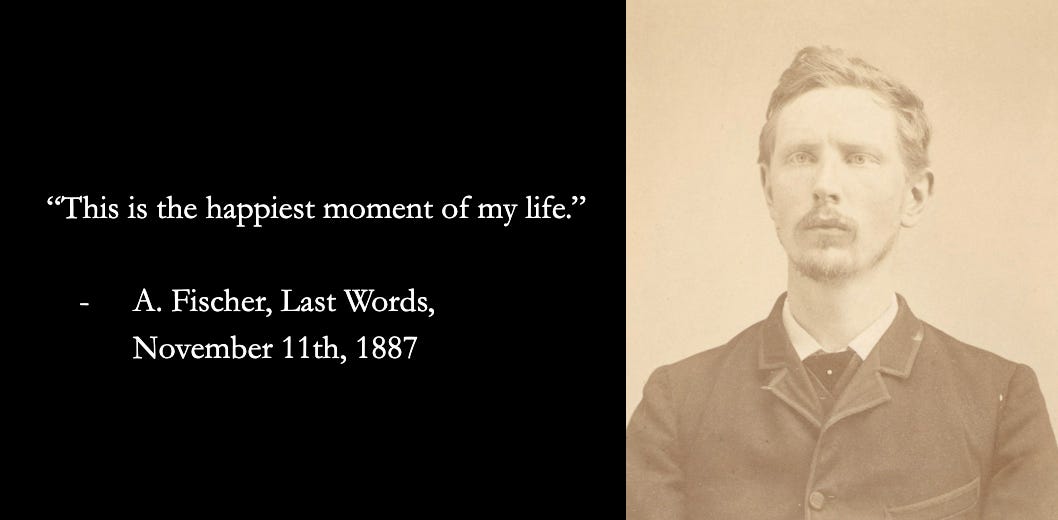
Fischerian Happiness
The four men condemned to death at the Cook County Courthouse gallows each had the opportunity to share some final remarks. August Spies opens with his most quotable: “The day will come when our silence will be more powerful than the voices you are throttling today”.10 Albert Parsons closes out the four with “Let the voice of the people be heard” and a continued attempt to speak right up until the trap door dropped the men to hang. Of the set, though, it’s the earnest optimism of Fischer’s closing statement that most haunts me. After echoing Engel’s “Hurrah for Anarchy!”11 he adds “This is the happiest moment of my life”. The system has failed him and now he’s been sentenced to death for committing no crime. And he’s… happy about it?
So, what is “happiness”?
In my work with a couple different wellbeing research nonprofits, this is a question I think about a great deal. Academics tend to try to measure this in three different ways:
affect measures (asking about frequency of positive and negative emotions)
life evaluation (asking about perceived sense of quality of life), and
eudaimonic factors (asking about structural characteristics that support human flourishing).
Where does Fischerian happiness fit in this? In general, he’s in the “eudaimonic” camp with a high focus on purpose. To simplify a bit: Fischer was a Marxist; Marx was a Hegelian; Hegel was a Lutheran12; Luther was a Christian13; and Christ was, in many ways, a Daoist14. We see these ideologies as incompatible, but what’s incompatible are the power structures that have built themselves around the ideas. What connects them is a shared view that the arrow of time is benevolent, revealing to us an eschatological utopia -- if we can only find a way to be in harmony with it.15
Fischer’s sense of happiness, then, resonates with global long-standing wellbeing traditions and academic measures, even as it also contrasts with some of our intuitions about what will bring us happiness.
Why does this matter?
We live in an uncommonly unhappy time. And Fischer’s comrades in the modern left seem to be particularly absorbed in doomerism and bad vibes. It seems plausible to me that our definition of happiness is part of what is driving this funk.
Fischerian happiness contrasts with how we’re told to think about happiness in most consumer advertising. We’re taught that the next new thing will fill our hearts, letting us escape lack and emptiness through action and acquisition. Certainly there is some happiness to be had in these pursuits, but it alone is not a complete strategy. Instead, we can find a different sort of satisfaction when we embrace the path ahead of us, no matter how bleak. It’s a sort of sublime peace where we stop fighting and let ourselves be caught up in the flow of the world.
Which isn’t to say that fighting is never necessary; our energy just can be more strategically focused. Our third word speaks to this more directly.
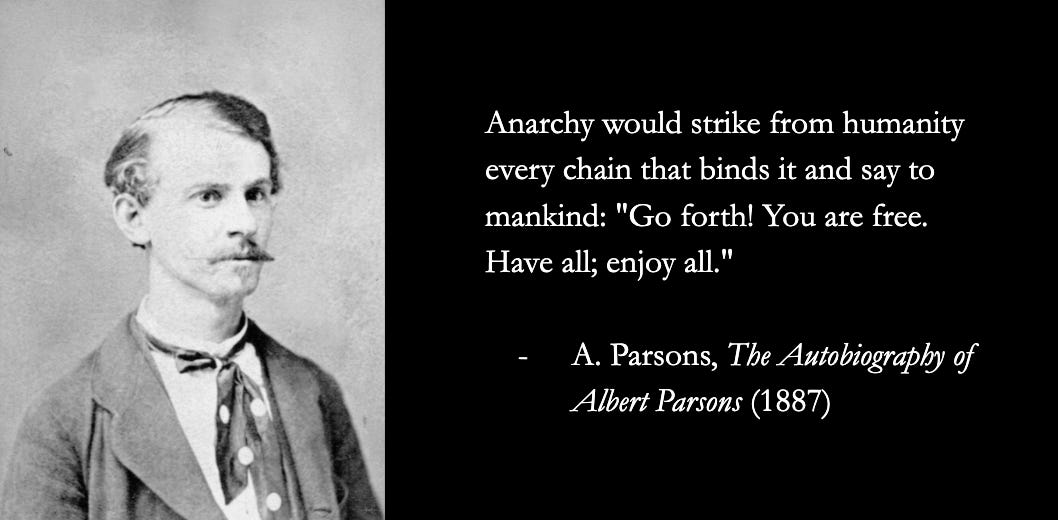
Parsonsian Anarchism
Because the scholarship on the Haymarket Affair tends to draw the relatively radical, Parsons can get a lot of flak as one of the most moderate members. With a personal ideological journey that spanned from Confederate to Radical Republican to Socialist to Anarchist, it’s perhaps unsurprising that his policy ideas and framings are peculiar.
The jury turned against Parsons based on articles he published in The Alarm in his “anarchist” period, but these were not articles he himself authored.16 The Alarm frequently published submissions that could occasionally be quite inflammatory; the “anarchist” ideas directly attributable to him are often surprisingly tame.
So, what is “anarchism”?
Here’s how Parsons describes his turn toward anarchism in his autobiography:
“In 1879 I withdrew from all active participation in the political labor party, having become convinced that the number of hours per day that the wage-workers were compelled to work, together with the low wages they received, amounted to their practical disenfranchisement. [...] I turned my activities mainly toward an effort to reduce the hours of labor to at least a normal working day so that the wage-workers might hereby secure more leisure from mere drudge work, and obtain better pay to minister to their higher aspirations. [...] Several Trade Unions united in sending me throughout the different states to lay the 8-hour question before the labor organizations of the country.”
To view a narrow policy like “reducing work hours” as an anarchist concept feels intuitively wrong to me. Anarchism is about playing loud music and graffiti-ing A’s in circles and the total abolition of the state; it’s so much more hardcore than just the 40-hour workweek, right?

What Parsons is doing here is combining a radical vision with an incremental, coalitional policy proposal. A fundamental reordering of the American political system would be a tough sell to many, but “more time off” has better public support and tilts the world toward the future he believes is possible.
To me, “Parsonsian anarchism” is about identifying the obstacles to human freedom in the world and thoughtfully designing popular and incremental political programs to remove those obstacles.
Why does this matter?
A lot of political activism today can skip the “hard part” of developing a popular incremental political program17, as if modern conveniences have made us as impatient with “the arc of progress” as we are with shipping. The Parsons approach focuses on immediate achievable objectives while maintaining long-term alignment with more dramatic goals.
This manner of thinking generalizes to other political projects as well. For me, I try to apply this approach in a globalist-populist context by designing new systems to help people better intuit the distribution of the global population -- whether with yìgions or dayborhoods. By confronting the obstacle of media distortion and providing alternatives, I can perhaps drive toward longer-term transnational neighborliness.
If you participate in a march today, you are continuing in this Parsonsian tradition. (Alongside his wife Lucy Gonzalez Parsons and his two children, Albert Parsons led the first May Day parade in Chicago on May 1st, 1886.) And so you may find it fruitful to reflect on his motivating question: What obstacles can be removed that are preventing the political engagement and independent flourishing of our neighbors and community members?
May Day Lessons to Live By
These three concepts fit in harmony with each other -- with Fieldenian Capitalism giving guidance for our own personal development, Parsonsian Anarchism guiding us for how we can improve society and Fischerian Happiness giving us a way to relate to the broader cosmos.
I think the three ideas can be summed up maybe something like this:
Sustain Yourself by Engaging in Voluntary Association
Embrace the Full Journey of Your Life Inclusive of Hardship
Think Radically but Act Incrementally and Coalitionally
I hope you’ll agree with me that this episode of history should not be relegated to just socialists and communists, who adopt it and adapt it to serve their own narratives. Indeed, even the Haymarket Eight themselves spanned diverse political ideologies. It should be no surprise, then, that their lessons can guide most anyone to lead a life that balances sustainability, service and meaning.
Happy 140 years since the inaugural May Day March! Here’s to many more.
(PS. If you liked this article but wish it was, like, ten times longer: you should check out my May Day reflection from last year!)
I did my best to document my visits to the hometowns of 63% of the Haymarket Eight.
I am a member of very few tribes in this world, but the Accor hotel loyalty program is one of them. (Are we allowed to be both a worker of the world and also in hotel loyalty programs?)
This turns out to not be the drum tower I wanted to stay by because I didn’t realize that each time a new dynasty would make Xi’an their capital, they would establish a different center. The Tang dynasty center and the Xuanzang monument that I was primarily interested in is actually quite far away.
My laundromat research project is continuing to progress slowly. Even if it never gets published, it at least is succeeding at making it less boring to do my laundry.
As a haver-of-two-names (“Eric” to family and “Harry” to friends), I feel a sort of kinship to cities in the same scenario: Xi’an/Chang’an, CDMX/Tenochtitlan, Istanbul/Constantinople, etc.
I can write all the footnotes I want though.
The founding document also establishes a man named William H. Jackson as the organization’s treasurer and secretary. Jackson had just a couple years prior served as secretary to Louis Riel, another martyr and also the founder of Manitoba, the Canadian province where my parents grew up.
Fielden’s definition is likely closer to Wikipedia’s, and the definition he imputes onto the Chicago Tribune is closer to the IMF’s. Wikipedia does later acknowledge in its definition section that “there is no universally agreed upon definition of capitalism”. Grokipedia more or less agrees with Wikipedia.
More etymology fun: The term “teamster”, still used today to describe truck drivers, was used for those who would drive a “team” of horses to help move heavy equipment.
There is some variance in the particular wording in sources, potentially because the quote was given in German? But the prose in Spies’s autobiography makes it clear he’s profoundly erudite in English, so potentially different folks just transcribed it differently.
“Hoch die Anarchie!” in German.
While I can’t say my interpretations of Hegel are standard, it is true that he identified as Lutheran throughout his life. Hegel’s famous work Phänomenologie des Geistes is focused on “Geist”, which is the word Luther chose to translate “spirit” (“spiritus”) in his translation of the Bible. I listened to Peter Singer’s Hegel: A Very Short Introduction audiobook, and Singer translates “Geist” as “mind” which seems to me to be either insane or a marketing stunt. Singer is obviously an incredibly decorated thinker, so I am probably wrong. I personally find most Hegelian philosophy largely inscrutable. On the topic of last words, Hegel’s supposed last words translate roughly to “There was only one man who ever understood me, and even he didn’t understand me”. Philosophers.
In their writings, the Haymarketeers are more open to acknowledge the connections between Christianity and Marxism than present-day Marxist-identifying people I meet.
I like to believe that when he spent his childhood in Alexandria, he was able to visit the befamed library and to encounter a broader range of religious ideas. This is not common doctrine, but I don’t believe it’s necessarily blasphemous either.
This common foundation between Daoism and Marxism is part of why the latter has been more persistent in China than elsewhere.
Parsons was over a century too early for “Section 230”, which protects modern media platforms from being held accountable for the third-party content they publish.
Slavoj Žižek calls this “politics without politics”, which he likens to decaffeinated coffee. Where we used to drink coffee for the caffeine, many now drink it solely for the taste. Politics used to be about achieving strategic objectives, but for many it is now either a participatory theater of pure self-expression (vision without tactics) or the operations of institutions/procedures for their own sake (tactics without vision).