

Don't Visit All The Countries
There are better ways to operationalize "worldliness". To start, we need to rethink why we even want to see the world in the first place.

As a traveling sort, I’m often asked how many countries I’ve been to. This is perhaps the most conventional way that travelers keep score1, but I don’t keep track of it.
I’m particular about how I craft metrics. Developing custom metrics was my specialty, working as a digital media researcher before stable, trusted measurement frameworks had become available. Measurement requires effort, and so thoughtfully selecting your metric ensures the time you spend to track it will be well-spent. And any good design process starts first with understanding the core problem we are trying to address.
For us, that means asking: Why do we travel? It’s not just for the fancy meals and the breathtaking views and to signal our socioeconomic status in dating app photos, right? Wherever we are, our locale has its own food and sights and ‘grammable glamoury.2 We don’t need to travel for those things. Plus, travel is annoying! It’s annoying to not know where we’ll find our breakfast. It’s annoying to file the paperwork to renew our passport. It’s annoying to sometimes forget our phone charger, and now our phone is dead and we can’t look up if 10,000 units of the local currency is a fair price or not. We endure this for some purpose. What is that purpose? And how might we measure that purpose?
I’d be curious to hear your answers, but as I’ve already written this essay some time prior to you reading it, it feels sensible that I go first. Personally, I try to understand what percentage of the contemporary human experience I have witnessed. My core travel goal is to optimize my odds of having literal common ground with the random folks whose life paths cross mine -- ideally, when they tell me where they are from, I can share with them how I’ve visited some landmark somewhere that is of some meaning to them. Travel gives me touchstones upon which I can build constructive working relationships.
In addition to this, though, travel is also an opportunity to see the world as it is, not merely as it is imperfectly represented. Three of my favorite quotes all play with the same principle: “the map is not the territory”, “all models are wrong; some models are useful”, “do not mistake the finger pointing at the moon for the moon itself”. And in this case, the map/model/finger in need of qualification is the notion of “the country”.
A Country Is Not A Country Is Not A Country
The nation-state is a relatively young framework, first incubated as a Westphalian religious war compromise in the 17th century, and then later strengthened in the 19th century when Napoleonic disruption of the Holy Roman Empire strengthened more provincial politickers. As a tool for reorganizing France’s major geopolitical rival, this system was effective for some time. Whether the nation-state serves humanistic aims is a matter of debate3. But as a framework to think about the varying peoples of the world, it’s deeply skewed.4
I spoke about “the screen door problem” earlier this year: the risk that an imprecise view of the world can cause us real harm. Our map of the world, unchecked by alternative models, can be a core distortion that poses such a risk. There are certainly some cases where understanding the political composition of the planet is occasionally useful, but it should not be our only way of envisioning the people of our planet. When we think of the world in countries, we prioritize politics over people. And we are inherently downweighting massive segments of the global population.
Here are three aspects to consider:
Population: Countries vary wildly in population. The most populous country, India, has 2.9 million times5 as many people as the smallest, Vatican City. Half the world lives in just seven countries; the other half lives in ~180 countries. If you’re traveling to understand the people(s) of the world, countries aren’t the right framework.
Sovereignty: While some countries make all their meaningful policies at the national level, this is quite rare. Most delegate some authority either upward to supranational bodies (the EU, Mercosur, ASEAN and ECOWAS) or downward to provinces, states or municipalities in a kind of federalist system. As for those nations that intend to govern their subregions uniformly, they often lack the state capacity to create this kind of uniform experience. Thus, even if you seek to see the world to understand its political variety, a purely country-based strategy still leaves you lacking.
Legitimacy: Different countries have wildly varying origin stories. Some fought wars of independence, others split amicably, and still others were formed by external elites. Some are homogeneous ethnostates, whereas others are more complex liberal coalitions. Many of the largest people groups have states with seats in the UN, but many communities lack direct representation. When we see the world as a collection of countries instead of a collection of people, we lose these distinctions.
When we see the world as “parliaments and flags” instead of “dwellings and faces”, we are seeing a sort of funhouse misrepresentation of the planet. A warped sense of the world interferes with our basic ability to understand reality. Merely understanding reality without noble vision and purpose can make for bleak politics, but a confused worldview makes even the pure-of-heart dangerous.
The solution I’ve formed to this is one I’ve discussed before: “yìgions”6. Each region has 100 million people -- or “yì” (亿) in Mandarin Chinese.
I think this framework is helpful as you explore the world in any capacity -- not just with travel, which is not always an available option, but also as you use media to interact with the world’s peoples. With this sort of self-run “Media Input Diversity Audit”, I try to evaluate if my experiences are truly cultivating a robust and complex worldview or if I’m just “drinking backwash”.
As I mention in most articles, the concept of “Middling Content” is intended to reference that successful media is inherently social -- that is, it mediates a relationship between people. I highly recommend experiencing the world without such intermediation when possible, but pragmatically we must rely on the media tools available to us. I try to use my own travel as a way to establish a ground truth against which I can evaluate the various media platforms available, and I can share this with my friends and family here.
And because I use dashboards religiously, I have a few key ways I measure my progress on this goal.
Four Ways to See The World
I’ve been continuing to work on the “Holistic Accounting” platform I shared last year7, and in particular I’ve added tracking of various personal metrics cut by these isopopulous “yìgions”. (These constructs provide no relevant support to the tax-filing process8, so I have again filed for an extension.)
Though I hope to broaden the capabilities with time, here are four ways that I evaluate my personal journey to try to experience the breadth of the world’s population. (I am still using the 2022 yìgion breakouts, but I’ll have an updated 82-yìgion map later this year.)
Victory by Travel
The most straightforward way to track my experience of the world is just by looking at which yìgions I’ve personally visited. And indeed, I’ve visited a good handful of them! There are a few ways I can measure this with my personal data:
I’ve been journaling daily since the beginning of 2020, and in the automated processing of the location I note at the top of many journal entries, I can see that I’ve journaled in 42 yìgions. I know this is missing a few, though, as I’m still working out some kinks in the automated geotagging component of my journaling system. So instead I’m turning to records I’ve had since 2012!
I was able to pull the metadata from every photo I’ve taken on my iPhone since 2012, and that gives a higher count of 59 yìgions. But some of these are photos I took through airplane windows of yìgions I haven’t truly visited, such as Iran, Central Africa and West and East Bangladesh9. So I’d guess I’m somewhere in the neighborhood of 50.
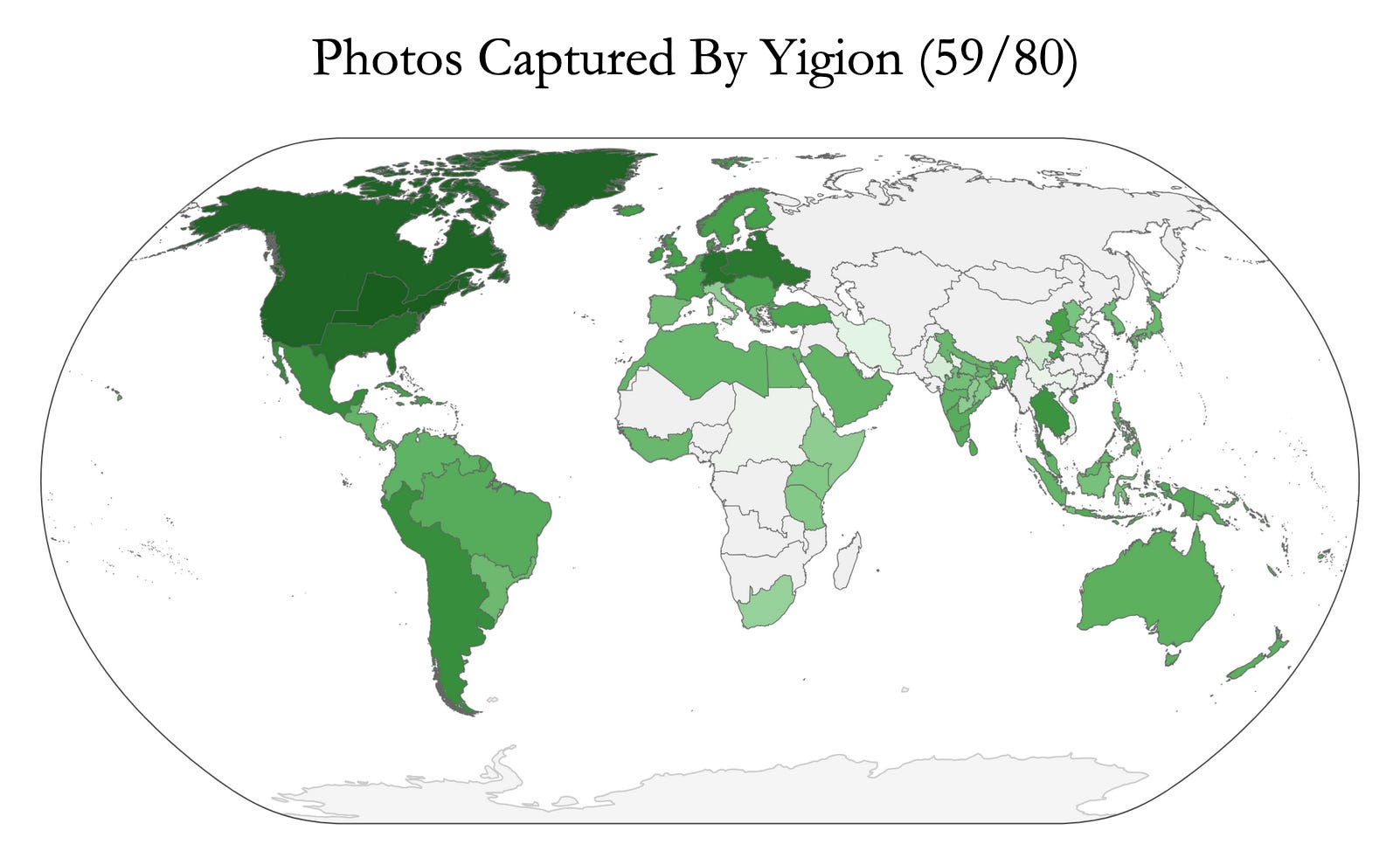
Regardless of how I measure it, though, I’m over halfway! Generally it’s probably best practice to have visited more than one city/province/country in a yìgion to speak to its diversity, but alas “easy mode” will grant me victory with a single short visit.
All this said, there are factors outside my control that may prevent me from visiting every yìgion, and the world is seeming less open each passing year. Thankfully there are win conditions that I have more agency over.
Victory by Reading
I make an effort to read news from a globally dispersed cross-section of globally oriented publications, but I’m not currently tracking that. What I do track is my (modest) audiobook consumption.
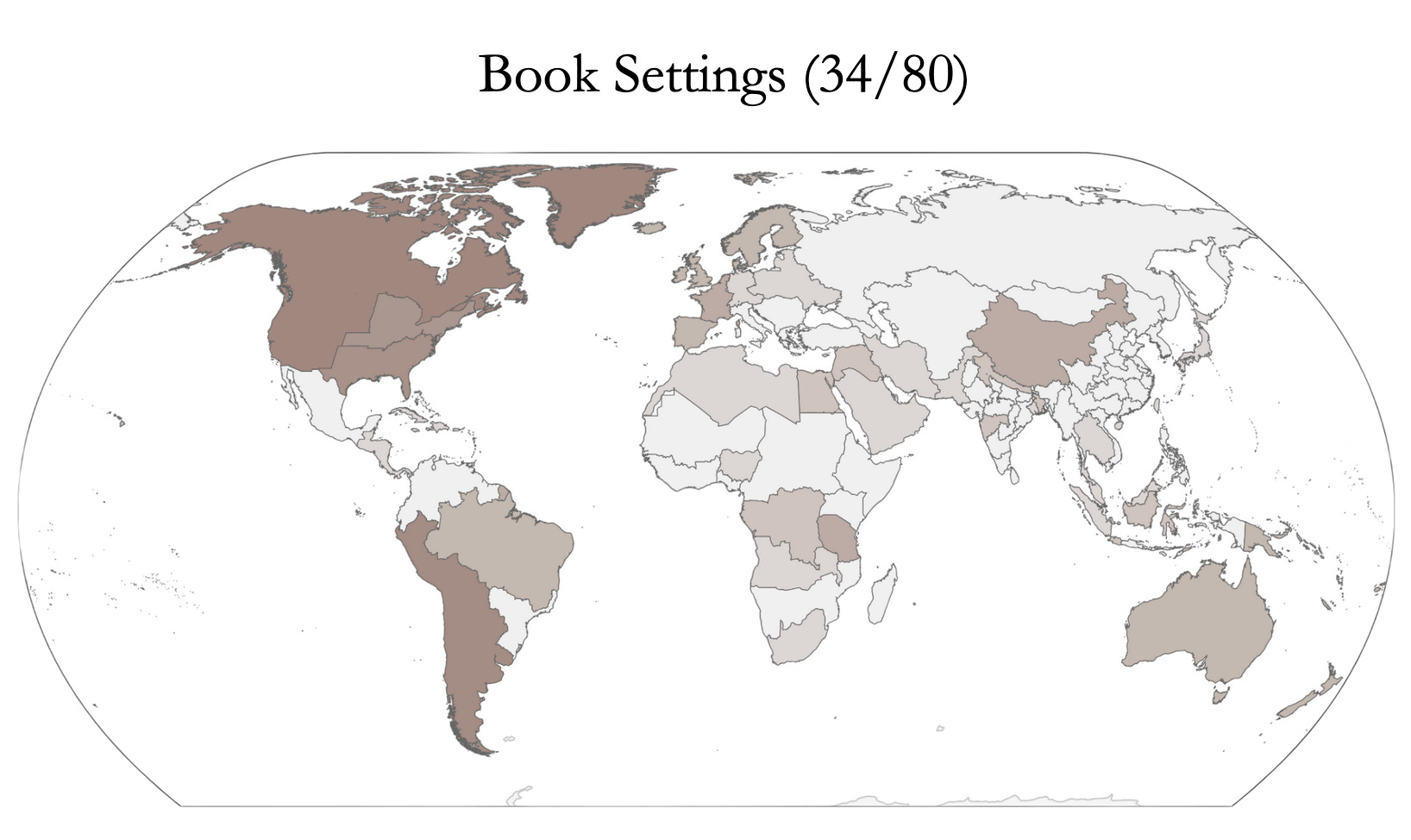
Since I started tracking my books in 2020, I’ve read books by authors from 15 yìgions and books that cover 3410 yìgions. (I mostly read broad non-fiction/history11, so these areas are occasionally covered in a book but aren’t necessarily the focus.)
Lots to improve on in this methodology.
I currently just pull this from a Google Sheet where I take notes on the books I read, but maybe I should integrate this into Goodreads or something.
How can I validate the authenticity of a representation of a place in a work? How is fiction different from non-fiction in providing grounding of a place? What settings am I reading about from endogenous vs exogenous sources?
Since I read history, how should I think about the balance of time periods in cultivating a clearer view of the world? Is it more important to read about the current region to say I’m truly “seeing” each of these distinct geosegments?
Books are wonderful because we can find interesting works about pretty much all regions of the world with relative ease. There have been millennia to compose them, and some of the best of them are quite old. Movies, with their mere century-and-a-bit of history, are tougher to source. Still, they are a delight and less of a commitment, which is why I’m considerably closer to this next win condition.
Victory by Filmgoing
Not every yìgion has its own movie industry -- but actors and directors tend to come from all over, and movies are a great way to encounter narratives of different parts of the world.
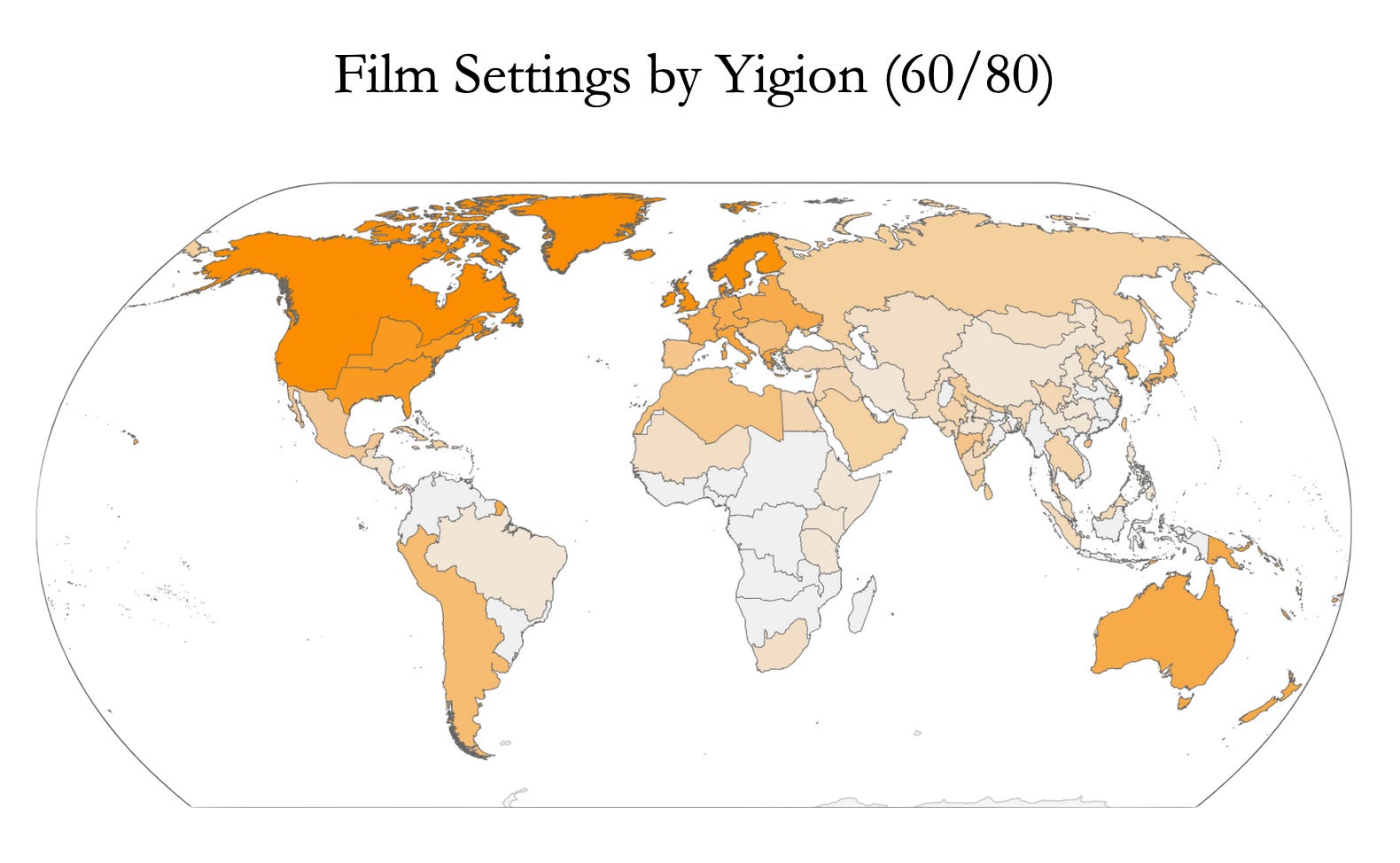
I’ve seen films set in 60 yìgions and from creative teams with representation in 72 yìgions. And, though it is perhaps less relevant, I’ve watched movies in 22 different yìgions.12
A film is the product of so many minds in collaboration, often from various backgrounds, so it’s hard to assess when a film is truly “of” a particular place. I’m running a global survey asking people about the movies they feel represent their communities, and I hope to report that out sometime soon.
I should probably expand this to include short-form video in some capacity, as some regions have more accessible short-form content than feature-length films. And further, the smaller creative team involved in many short-form videos means it is easier to get media that is wholly produced by the talent of a specific locale. Ultimately, it’s easier to craft a population-weighted cross-section of the world with short-form video.13
If I only have a couple minutes to explore a place through a media artifact, though, I far prefer listening to its people’s pop music.
Victory by Audio
As discussed before, I like to use music as a means of connecting with people across cultures. And just like anyone who listened to my 2022 UN Playlist14, I’ve connected with all 80 yìgions through music.
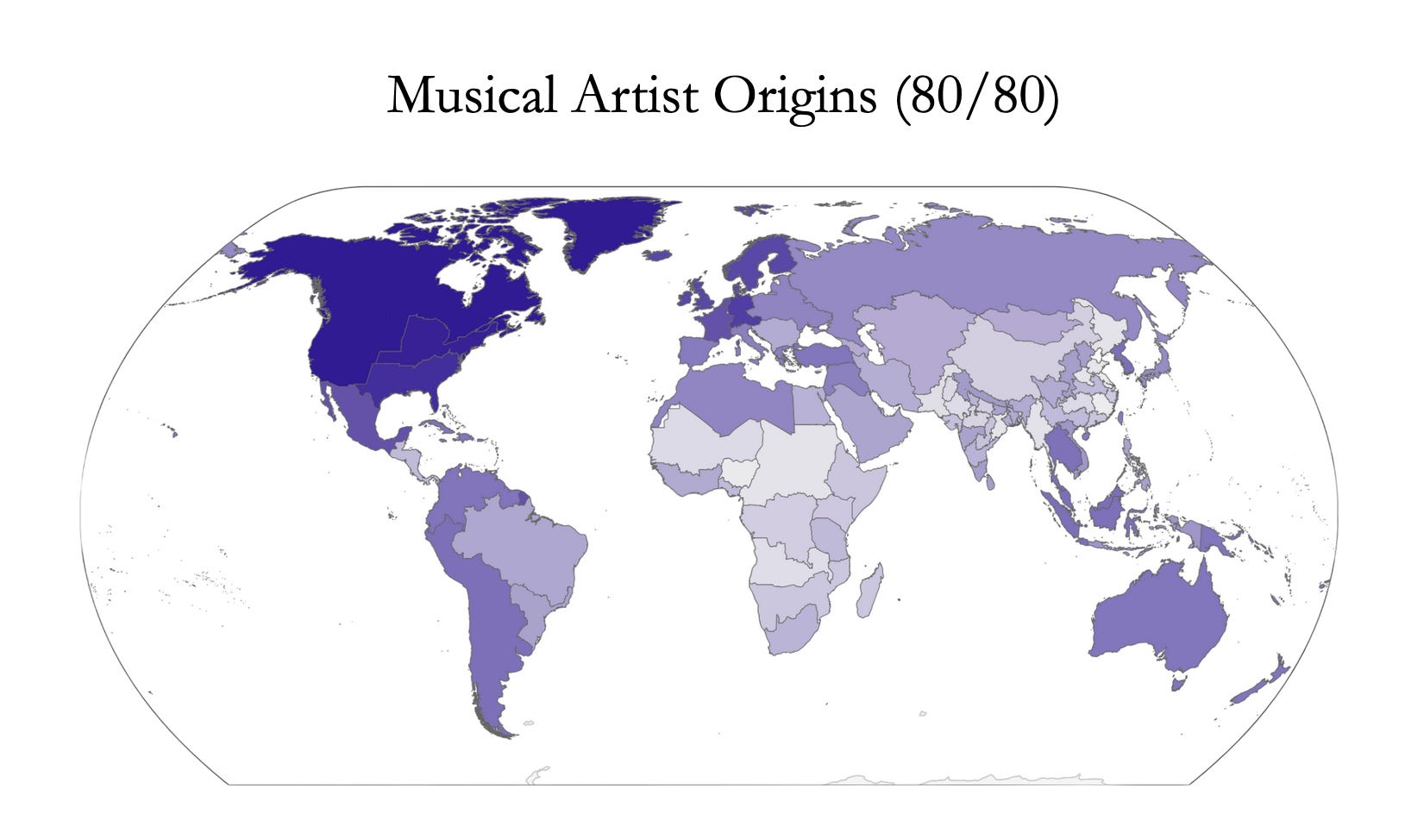
Even having “won” this particular goal, though, this framework still helps me find gaps to fill!
For example, I’ve listened to 20X more minutes of music from South Nigeria than North Nigeria. I also have general weakness in my listening in Central Africa as well as several yìgions in India and China. And there’s also taking this to the next level: each yìgion has roughly 10 “crormunities”15 inside it, so a higher-resolution playlist-picture is possible.
I will still take a moment to feel proud here, though. I had been developing this framework for years and first released this system on November 15th, 2022, the UN’s “Day of 8 Billion” when the global population was estimated to have crossed 8 billion people. ChatGPT would be publicly released as a “research preview” just two weeks later on November 30th. And while it could have made this kind of research so much easier, I’m kind of glad I got to do it the long and slow way.
A Unified Worldview Scorecard
While the granularity of four scores can be useful, it’s ultimately easier to put them into a single measure to evaluate incrementally. Just as an LLM-driven chatbot is the product of the content used to train it, we are the product of the experiences we feed into our eyes and ears. Understand your viewing of the world, and you’ll understand your worldview.
Though the length of time16 I’ve been tracking each of these measures varies, I can compile these data sources and plot my progress to bask in the marvel of line-go-up. This helps me assess my performance both annually and cumulatively.
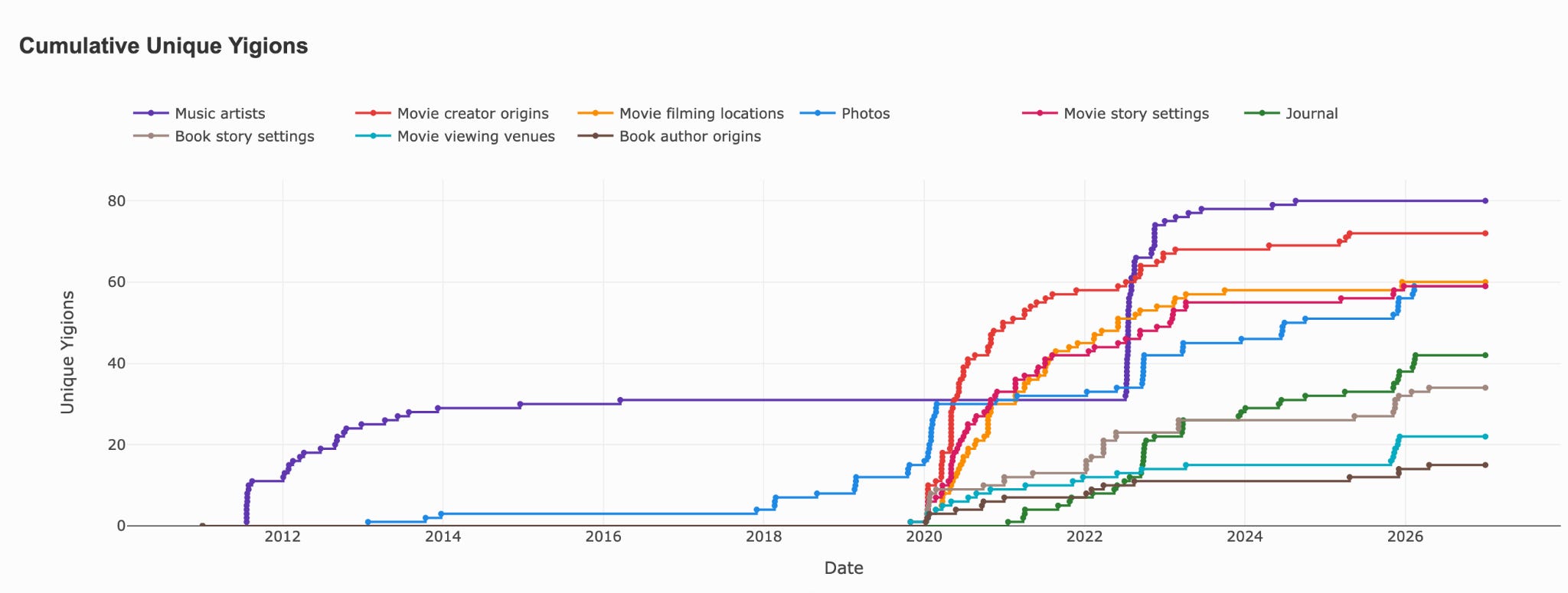
I see this “score-keeping” exercise as mostly something for personal growth -- a competition with oneself. While I’m unsure I’ll be able to personally travel to all the yìgions, I do set the goal of achieving the three media-based win conditions.
But since managing so many win conditions is a lot to think about for so many yìgions, I instead frame my goal as follows:
I seek to visit all the yìgions I am able to visit, hoping to experience a place “unmediated”17.
For the places I can’t visit, I seek to connect with a narrative work (book/movie) about the place from a resident.
For the places where I cannot access a narrative work, I seek to connect with an aesthetic work (music/art).
I see these as three incremental levels of “depth of experience”, where direct “unmediated” experience is deepest and aesthetic is lightest. (Ideally all three can be achieved, and I think experiencing them in order allows each step to enrich that which follows.)
At present, I’m at least at the “aesthetic” stage for all 80 currently defined yìgions.
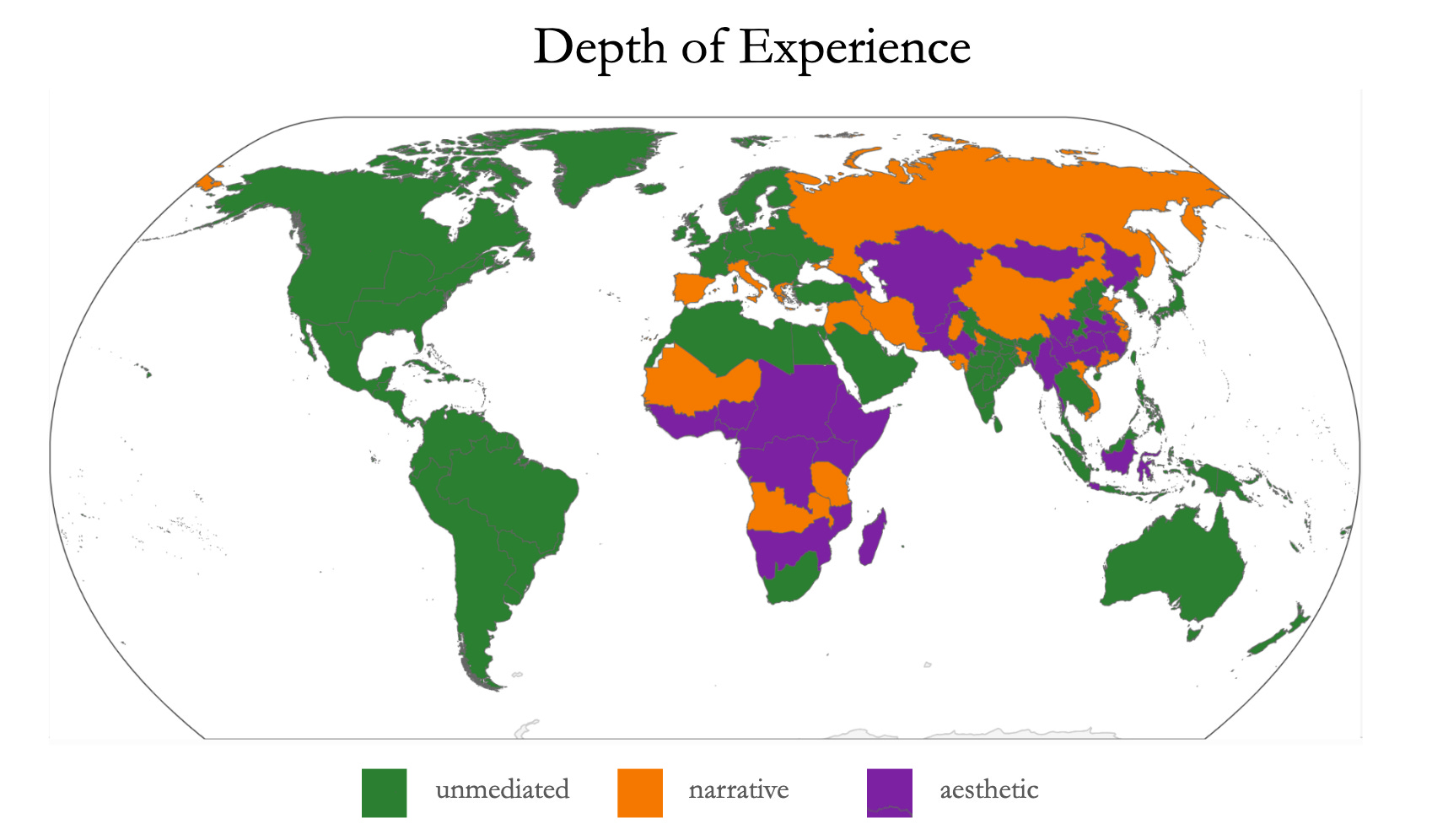
I should be able to connect to 100% of the world’s yìgions at the narrative level in the next year or so, and then I can further aim to pass through a few adjacent yìgions each year. I’m hopeful that the travel climate will improve, but even if it doesn’t I will explore new ways of connecting to other parts of the world with less intermediation.
…Why Make Things So Complicated?
I’m not directly asked this often, but my sense is this is how most people respond to my creation of these frameworks. And further, I understand why people ask. This is all quite complicated. (I always think I can write one of these articles in a few hours and they usually end up taking weeks.) Many find their epistemic grounding is stable enough without a supplemental geographic model; a new geographic framework like this seems like a lot of squeeze for no juice.
First, it is my goal to make all of this less complicated -- though knowing 80 (or 82) yìgions is already relatively less complicated than knowing 195 countries. (Not to mention that the four-quad framework I discussed last year and the broader “7 Billionishes” framework both are simpler as well.) Second, I truly do think the nation-based framework is insufficient to understand the world and that this poses risks to those who live in it (i.e., us). And third, I think that valuing humans as humans means thinking about humanity in more human-derived terms.
But maybe part of what makes people inquisitive is a desire to understand if I’m bank-shotting toward some particular political objective. Maps are deeply political of course, and anyone reading this without a personal relationship with me is right to be skeptical; it is healthy media literacy practice to inquire about motivations and incentives.18 So I’m going to blurb a little about why this matters to me.
The idea of a better media has been central in my professional life. I worked as a media researcher for a decade, helping new media companies demonstrate the power of their platforms. At the time there was skepticism from advertisers about the new-fangled world of digital advertising, but now these companies -- Meta, Google, Twitter/X -- are the foundation of the American economy. My first jobs were also all in the media space more directly: music teacher, 35mm film projectionist, live sound technician, radio DJ and more. I want media to flourish in a human-aligned way. (The “alignment problem” is not a new one in the media space.) In my journal, I start each day asking myself how I intend to help improve the media19. This is, to be unseemly earnest, the vocation I’ve been working toward for decades of my life.
Even before my career, though, global media was central in my upbringing. I grew up all over the place, which I gloss over as “a series of foreign islands”, spending much of my time in international communities that provided me with physical spaces where I could interact across lines-of-difference with meaningful common ground. Schools and malls are media instruments too, and I was grateful that those of my adolescence provided such cosmopolitan grounding.
And yet it’s deeper than just my own upbringing. It is found in my ancestral people groups too20. In one line, it’s found in the voyageurs canadiens who traversed the St Lawrence and Mississippi water systems, connecting the Algonquian-language-family-speaking peoples in systems of trade, with some even fighting/dying to defend them. In another, I see it in the Ukrainian/Ruthenian subsistence farmers escaping an unraveling empire of the Old World to cultivate the Manitoban prairies of the New World. My own parents’ continuation of this journeyman spirit is what gave me my own transnational upbringing.
So I will continue in the mission and am hopeful that I can share frameworks that make the wide range of global media less intimidating and more parseable. It is not clear to me whether I will find a financially sustainable way to do this kind of research21, but it is my intention to at least provide some tooling that will help others on their journey to see the world as it truly exists -- as ~8.2 billion people and not ~195 countries.
An alternative approach that you’ll sometimes see: Two people will be in conversation when one person will name a city that they have been to. The second person will then share if they have also been there. After that, the second person will provide a city they have visited, with the first person noting if they have too. This continues until a city is identified that one but not both conversationalists have visited. You could assemble a series of such conversations into a tournament bracket.
I took a seminar on Thorstein Veblen in college and I almost found a way to work Veblen goods into this sentence, but couldn’t quite work it out. Still, this sentence is the closest I’ve ever gotten to using that class in real life. Next time maybe.
Raised in the neoliberal polycultural paradise of Singapore, I personally am deeply skeptical of the nation-state model.
The spread of the metric system under Napoleon was pretty good though, as was the re-discovery of the Rosetta Stone -- starting a series of re-discoveries that would help us re-learn that Julius Caesar didn’t invent the calendar named for him. Not “build-a-giant-public-arch”-worthy in my opinion, but what politician deserving of such an arch is ever the sort to commission one, right?
Worldometer has India at 1.47 billion as of publication. It has the Holy See at 500.
If you didn’t catch my attempt to represent the world’s 2022 population distribution in a playlist, here you go: The World Isn’t Small.
I like to think that article was commenting on the SaaSpocalypse before that became a mainstream buzzword.
The yìgions are mercifully abstract; as such, they require no tax revenue and wage no war.
East Bangladesh, West Bangladesh and West Bengal each contain roughly 100 million people and so they are each yìgions.
I think this number should be higher but the processing of associating books with settings is something I’m still improving.
Fiction was invented by elites trying to distract you from learning your history.
I enjoy how movies are a portal to other places, and so it’s always of interest to me how these portals are distinct in different parts of the planet.
In theory, social media algorithms could make representativeness their objective rather than engagement, though I expect such a strategy would confront both economic and political obstacles.
It’s now less complete because of link rot, but I intend to have a new playlist soon, hopefully with more direct input from the people of each region via my global surveys.
A “crormunity” is a community of 10 million people, or “one crore” in the Indian numbering system.
Note: there’s a gap in my listening data around 2017-2021 when I switched from Spotify to YouTube because I got really into vaporwave. (So good, right?)
“Unmediated” is not really possible, as tourism encourages regions to perform a somewhat distorted version of themselves. And my limited language skills require me to operate through translation apps, which are still screen media. Still, it’s an aspirational artifact! It’s only the finger pointing at the moon!
It’s possible we used to live in a world where we could just trust products without caring about who made them, but I’m not sure that’s going to be true in the future we’re heading into. I’ve watched useful software tools mutate, becoming increasingly extractive and dehumanizing until I could no longer use them. I think you should probably want to know the incentives and motivations of the people who are building your software.
Technically I ask myself “¿Cómo voy a mejorar los medios?” because I’m still journaling in Spanish to try to keep up some of the vocabulario that I had worked up for my presentation earlier this month. Also I have my journal guide me in a breathing meditation first that is only successful at most 30% of the time. Journaling is hard. More on “win conditions for journaling” some other time.
In full disclosure, I think it’s sensible to be a bit squeamish about anyone who is too invested in their particular lineage. I’m aware that since each of us has thousands of ancestors, the odds that anyone has exclusively admirable/noble ancestors are basically none. These things are complicated. That said, I also think looking to the parts of our history that inspire us can be grounding and validating, and I feel lucky to be descended from inspirational folks that are broadly aligned with my globalist worldview.
I run a small survey research company and I’m trying to make it easier to conduct surveys using this isopopulous approach. If you have a question that interests you and you want to survey the world, please reach out!