

The Great Calendar Heist
plus: birthday magic, suffocation prevention, a “media winter” guide, and free fergie

Happy January!
And for those who observe the new year starting January 1st1, Happy Belated New Year!
Of course, as widespread as the calendar is globally, many choose another day to celebrate. My previous holiday analysis found that New Year’s Day was the second most common holiday globally, with ~77% of the population residing in parts of the world that have a public holiday on January 1st. And most in the largest country that observes the holiday, China, save their biggest new year celebration energy for the Lunar New Year a few weeks down the line. This is all to remind you that you have some freedom in choosing when to mark the start of your own personal new year.
I may have gone too far in closing out my New Year’s Eve email with the claim that January doesn’t exist; the month seemed compelled to aggressively assert itself. On the second of January, I woke up to a shaking room and earthquake alarms in my Mexico City Airbnb. And then on the third, I woke up as we all did to the news that the US had seemingly invaded Venezuela. But while I acknowledge time always moves forward, I still will make a case for treating this month as a part of an inter-year period. (With the awareness that sadly there is no forcefield protecting this or any month from historic or terrible events.)
A third (less jarring) surprise for me was that Substack’s official newsletter was promoting an article that gave a rundown of the surprisingly recent (to me at least) adoption of January 1st as New Year’s Day -- which I had teased in my December newsletter as the topic I wanted to explore.

It gives an amusing but clear summary, and I recommend it in full, but I’m going to specifically focus on the Julian calendar, which the featured article introduced aptly:
The lunar calendar of Numa Pompilius with its scanty 355 days fell out of sync with our actual 365-day solar year, resulting in all sorts of agricultural complications. Planting usually occurred around the vernal equinox, but the calendar had drifted away until the equinox fell in mid-May, which now had no relevance to the agricultural year. The calendar was an unreliable mess.
Julius Caesar decided to fix this. He invited the Alexandrian astronomer Sosigenes to put the calendar in a more sensible order. Sosigenes advised dropping the lunar system altogether and, for the first time ever, basing the year solely on the sun. This idea was met with howls from the Roman priests, who depended upon the lunar calendar for their rites.
But Caesar said it was to be so, so it was so. However, the calendar was at this point utterly out of rhythm with the solstices and equinoxes and in order for Sosigenes’ calendar to re-sync with the agricultural year, a hard reset was needed. The Long Year (or ‘The Year of Confusion’ as it became known), 46 BCE, lasted 455 days. The next year, 45 BCE started on 1 January.
While Substack is becoming more of a “social media” style website, I generally approach my writing in a very independent manner. That said, a benefit of writing within a broader community is I can defer on some topics and go deeper on ones more central to me. Such is the case with that Romanticon piece. And I’ll let it serve as an amusing review of the broader historical record, saving me the details -- which is great, because it means my new year’s post won’t end up getting sent 143 days2 after the holiday. (I’m just 12 days behind the holiday I’m reflecting on this time! Thank you, Romanticon!)

With the basic contours of the history established, there are a couple areas I want to focus our attention on to build a foundation that will support my advice on handling January and winter more generally: (1) that the revival of the 17th century practice of dual-dating as a healthy year-to-year transition and (2) that Julius Caesar is perhaps not who we should credit for the so-called Julian Calendar. And then I’ll apply these winter ideas to media practices and close with a seasonal song recommendation.
Let’s take these points chronologically by taking a closer look at Caesar and the origins of our modern calendar system.
How Julian Is The Julian Calendar?
The calendar history article makes Caesar out to be more of a technocratic statesman. And while I hate to speak ill of the stabbed-to-death, I’m personally not so sure. There is no direct record of Sosigenes and Caesar meeting, only a reference from Pliny the Elder a century later; while I’m confident Egyptian astronomy is involved, I’m skeptical of the particular dynamics. Maybe it’s better to present the elements of the case and have you reach your own conclusions.
First, let’s recap what we know about the early Roman calendar:
Rome’s earliest calendar is credited to the legendary 8th-century king Romulus; it had 304 days.
Romulus’s successor Pompilius would add winter months to create a 355-day calendar.
To the southeast through the Mediterranean, though, we find another calendar:
Egypt, in contrast, had been using a 365-day calendar from at least 2510 BC.
In 238 BC, Ptolemy III reforms the calendar, adding a leap year; his reform is ignored.3
Ptolemy III would have a great-great-great-great-great-granddaughter4 named Cleopatra VII.
Cleopatra is a historical figure of much renown, known for wisdom and speaking perhaps as many as nine languages. And since she is the descendant of the man who proposed the first 365-and-¼-day calendar, the development of the Julian Calendar is particularly interesting through her eyes.
Let’s cover the timeline quickly.
48 BC: Cleopatra (age 21) meets Julius Caesar (age 52) when he visits Alexandria.
47 BC: Caesar returns to his wife in Rome, and Cleopatra gives birth to Caesar’s son.
46 BC: Cleopatra moves into Caesar’s villa in Rome, and Caesar proposes the new calendar.
45 BC: The new calendar is adopted.
44 BC: Caesar is killed.
So we are to believe that the Romans, who were fine with wrong for 700 years, just decided to make somehow it’s the same year that the emperor’s Egyptian mistress lives with him -- who just happens to be a direct descendent of an adopter the world’s first 365-and-¼-day calendar -- that Rome adopts a 365-and-¼-day calendar.
I mean, which do you think makes more sense? Naming the calendar for the middleman adulter-tyrant who was killed by his own people? Or naming it for a representative of the culture that collected nearly two millennia of astronomical observations that made the calendar possible?5
The naming choice here made me think of one of my favorite listens last year, a new audio biography of Nigerian Afrobeat innovator and activist Fela Kuti titled Fela Kuti: Fear No Man6. Specifically, I’m reminded of the episode “Teacher Don’t Teach Me Nonsense” which explored Kuti’s activism promoting decolonized education. One of the hypotheses discussed: the works of Aristotle are actually works of various ancient Egyptian philosophers, merely disguised as Greek.
While it’s still a far-fetched theory to me, seeing how the Romans so willingly branded Ptolemy III’s calendar with Caesar’s name, the idea seems less preposterous.
This can be a bit depressing, reading how the powerful get to stamp their name on the achievements of others, but I also think there’s some positive to be gained from the history. For example, those with 2026 relationship goals can use this story as a helpful reminder that dating isn’t just about finding a long-term partner; it’s also about learning new calendars to bring back to your empire and name after yourself.7
More seriously, though, I am awed as a researcher by how the so-called “Julian Calendar” has roots within continuous data collection efforts across millennia. Egyptian astronomers nearly two millennia before Caesar and Cleopatra would squint toward the sunrise to see if a rare star called Sirius was visible, documenting (even if unknowingly) the earth’s rotation around the sun. These records were how astronomers contemporaneous to Caesar could estimate the length of a year with accuracy. So when you count down to celebrate the new year, you are using a technology with development stretching back over 4000 years.
Sure, the Egyptian laborers who built the pyramids created a physical structure that still draws crowds today, but the Egyptian star-tracking data entry professionals worked on a project that actively provides utility to nearly everyone on the planet. Their calendar is no less a wonder of the world.
As for how this calendar factors into Caesar’s killing, that murder mystery has not been resolved.8 That research will have to wait. Because just as there’s a lesson to be drawn from the 45 BC adoption of the Julian-ish calendar, I also think there’s a lesson in the 1582 Gregorian reform and the centuries it took to take hold.
Unlucky Stars and Birthday Transfiguration
This was in part because Pope Gregory XIII was really into the works of another Egyptian Ptolemy: Claudius Ptolemy9. Specifically, Pope Gregory didn’t like how the calendar was shifting, because it made it difficult to do astrology.10 This was the same time period of history where we get the word “influenza”, literally Italian for “influenced” because the flu was thought to be “influenced” by the stars. Influenza could then, and still can now, kill you. If you believed the stars were killing people en masse, you’d want to track their positions effectively too.
Pope Gregory was more effective than Ptolemy III at getting people to listen to his calendar reform. Lots of people, actually. Maybe they were worried about the killer stars, or maybe they were just excited to be a part of time-keeping history. But not everyone complied. Some were followers of critic Martin Luther, who didn’t believe in this whole “stars business” because it wasn’t mentioned in his magic book11. And so for centuries, Western Europe would operate distinct calendars.
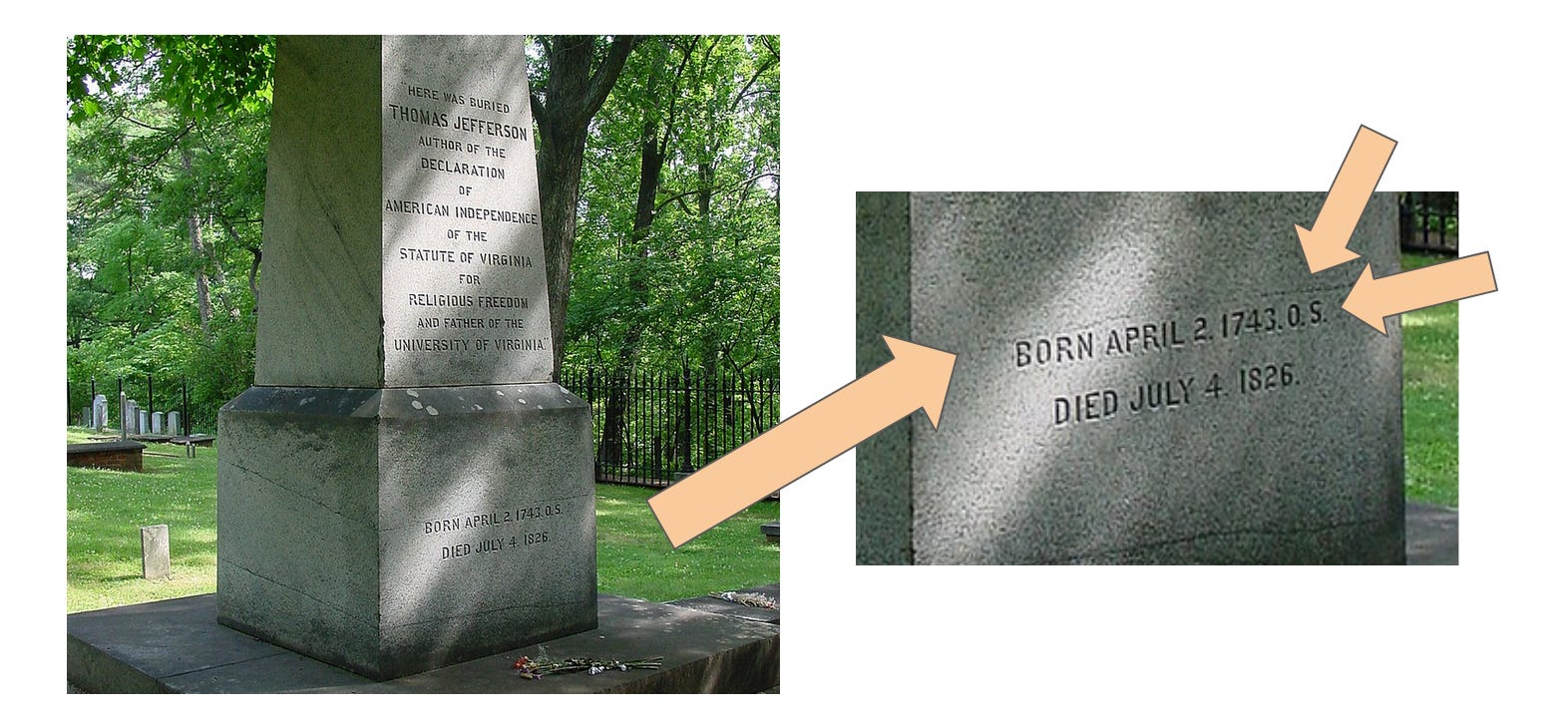
This created a sort of split in time’s fabric. If you visit the grave of popular musical subject Alexander Hamilton, you may notice that there is a clear lack of any visible tear in time’s fabric. But if you visit the grave of Thomas Jefferson (from Act II) you’ll see it plain and clear -- a mark from how the King12 changed his birthday on him!
The abbreviation “O.S.” after his noted birthday (April 2nd, 1743) stands for “old style”. This means the date uses the “Julian” calendar rather than the Gregorian adjustment. Indeed, many of the characters of Hamilton had their birthdays changed by the King in this manner! One of the signers of the Declaration of Independence named Carter Braxton13 not only had his birthday changed, but had his 18th birthday skipped altogether since it was in the “time jump” in 1752 between September 2nd and September 14th.
But the Calendar Act of 1750 didn’t just change the birthdays of characters in Hamilton, it also changed when the British celebrated New Year’s Day. The British Empire had treated March 25th (“Lady Day”) as the start of the new year, which would cause confusion when interacting with the rest of the world. This is a completely independent inconsistency from the one caused by the Gregorian Calendar.
To attempt to resolve confusion, dates in January, February and much of March would feature both the prior and upcoming years. This practice was called “double-dating” or “dual-dating”, and it can be observed in documents in Britain and its many colonies.
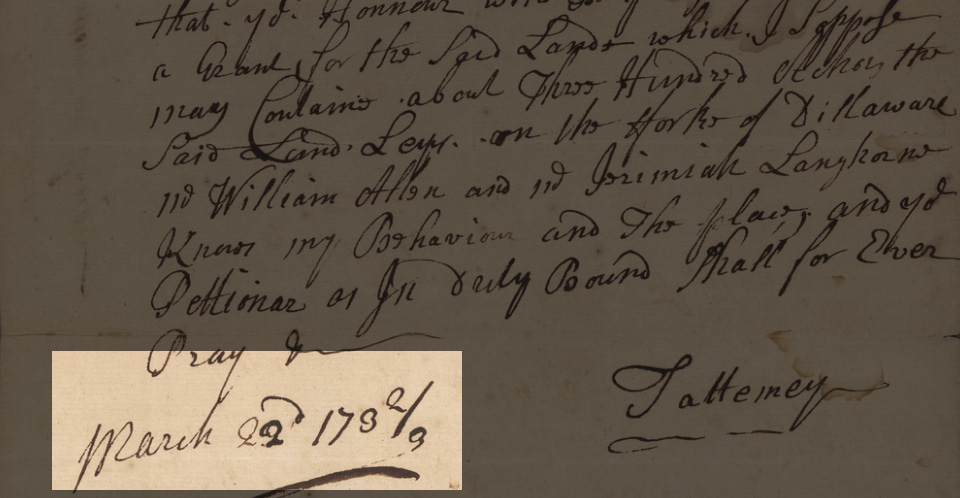
With the passage of the Calendar Act of 1750, January dates from 1752 onward could be unambiguously expressed without doubling up on years. Indicating only one year was now sufficient.
But at what cost?
A Month for Middling
January was named after the god Janus, who had more faces than most other gods: two. In high school, I had friends that worked at a coffee shop14 called Janus that featured the front-and-back-facing god’s likeness in its logo. I think this gives me authority to speak on behalf of Janus and say that he likes how dual-dating honors his dual-faced nature. He thinks it’s kind of sad they got rid of it, and he thinks you should maybe give it a try.
I’ve been journaling daily since the start of 2020, and I organize my entries into monthly documents. Because I set goals aligned with the seasons using the solstices and equinoxes as milestones, it’s easier to align the monthly documents to begin/end with the shift in the classical astrological month rather than the modern calendar month. I like in particular how it gave me around a week of preparation for the coming month change. Sort of like the “setting your clocks early to make sure I show up on time” scenario, but on the scale of several days.
This means that my current entries are indeed for “Winter 1 2025/2026”, and they have been since the Winter Solstice. I won’t double-year-date all the way to March 25th, but a month of it could really help with the year-to-year whiplash.
If you’re a bit stubborn like me and resist rapid transitions, maybe keeping this tradition alive may help you too.
So far I’ve shared lessons on (1) expressing gratitude for a calendar built on millennia of astrology research and (2) considering dual-year-dating journal articles to ease transition between years. These have drawn more on the specific history of calendar consolidation, which I enjoy because it creates a globally comparable perspective on time through which different cultures can understand our shared histories. This is what Middling Content is all about.
But there’s one more general lesson before I get into specific media guidance, and it doesn’t rely on historical particulars. It more just asks you to listen to nature around and to listen to your human body.
How To Not Suffocate
I personally hate letting go of things. I hate goodbyes and I hate death and I hate breakups and I hate getting out of the shower and I hate taking down Christmas decorations. I tell myself I watch movie credits out of respect for filmmakers, but I mostly just don’t want to leave the theater yet. Endings are miserable. Beginnings are where the fun is.
So when January comes around, I, like many people, want to focus on adding new stuff to my life. I’m compelled to jump to the next beginning. New habits, new experiences, new wisdom -- why not begin them all? Let’s start on the right foot. Let’s think positive. Right?
If you’re north enough, you can probably see outside that nature is teaching a different lesson. It’s not necessarily intuitive to grasp, though. Yes, we see that flowers die in the fall and new flowers bloom in the spring -- but can’t we have new flowers without losing the old flowers? Why can’t we just pursue a floral “abundance agenda”?
Breathing, in contrast, is deeply intuitive to all living things. And winter is a good time to remind yourself: you cannot inhale unless you exhale.
Inhalation Requires Exhalation
Here’s an experiment that you can try at home. For around 20 seconds, try to inhale without exhaling. You can a little, probably. And then a little more. But then you’re mostly stuck. Maybe there’s a little involuntary exhalation that you replace with more inhalation. But that’s not enough to nourish you. If you’re more ambitious than I am, maybe you’ll pass out and your body will force you to exhale. (Don’t be that ambitious. That’s not the point of the exercise. It is the exact opposite of the point of the exercise.)
Now spend 20 seconds breathing normally. You’ll find you take several good nourishing breaths in 20 seconds when you allow your body to function as it has since you were born.
If you only focus on inhaling, you actually can’t inhale that much. It is the act of exhaling that allows you and prepares you to inhale. And on top of optimizing the volume of air you inhale, exhaling also has the added benefit of sustaining your life. It is through clearing the field that we grow new crops. It is through giving that we are able to receive.
This lesson of balance is central in the religious foundations of nearly everybody on the planet, whether they are orthodox practitioners or follow secular philosophical offshoots. I wrote about notions of balance within Daoist-Secular, Hindu-Buddhist, Christian and Islamic traditions last year in my post “A Pocket Canon to Shrink the World”, if this kind of pan-religious grounding is useful. Middling Content focuses on mediating the collective human experience, so I try to be mindful of broad traditions when extrapolating about “the human condition”.

To add to your life without creating space is like exhaling without inhaling. This is what adding new year’s resolution habits and practices is like without taking time to clear out the old ones. In the world where we select-all and click-and-drag to digital trashcans, deletion is expected to be instantaneous and easy. But if you’ve ever packed up an entire apartment, you know that clearing things out takes time. That time needs to come from somewhere. Winter is that time!
Winter is nature exhaling. And it’s a good signal that we can do the same, letting go of the things that no longer serve us.
My mantra for last winter was “nest, rest, self-invest”, and I think I will pick that up again. All of these can be interpreted in a “winter” sense: nesting as decluttering home space, resting as creating more space in the day, and self-investment as focusing talents and energy by unloading the peripheral.
Since unmet expectations are a potential driver of January 1st’s calendar-leading deathcount15, I think saving the resolutions for a warmer season can make for a more thoughtful and pleasant transition into the new year.

If you align your new goals and new starts with springtime, then winter is a time to reflect and make room. And since I focus on the “middling technologies” of media in this newsletter, I have some suggestions on how to clear up some room through mindful reductions in media usage.
Wintering Your Media to Free Your Mind
One way to think about a “Media Winter” is to ask yourself “What would Dry January look like for my media habits?” Different people will answer this differently, because different people have different challenges with their media. Some people maybe need to cut back, and others could use it more proactively to reach their goals.
As a general approach, though, I think the conceptual arc of winter would have us scale back and spend less of our time mediated. For some this would mean spending more time with the people around them, and for others this would mean spending more time with themselves. From a single day-long media fast, you’ll get two waves of insights: first, when you experience the novelty of the break; and then second, when you reintroduce media with the context your break provides.
Identify Your Media Habits & Opportunities
This is not setting resolutions! Winter isn’t for adding new things!
This is for reflecting on your values and examining how they intersect with your current media habits.
You can think of this as a series of three questions:
What are your pre-existing goals? What do you need or want more of in your life? What do you need or want less of? The answers to these questions will be essential context when evaluating your media habits. Media is seldom good or bad in itself, so having some sense of your independent objectives will help.
What media do you interact with within a given day? Maybe it’s apps, email, websites, streaming video, TV, etc. These are the places where you can look to make adjustments or changes.
Ask yourself, “If I want to (see my friends / get a raise / exercise more / talk less loud in public places), what media might be hurting that?” And specifically for the winter, we’ll be attentive to what is counter to our goals. Your inputs determine your output, and the media you consume are the inputs into your mind! Be mindful of them!
A piece I wrote last year investigated how advertisers and TV studios think about “good media”. I guarantee there are marketing professionals at this very moment planning what they want you to read, watch and/or listen to this January. Don’t let them do all the planning!

When you have a sense of your goals and habits, you’re in a better position to tidy up your key media portals: your phone, your inbox and your feeds.
Purge Your Smartphone Notifications
I’ve spoken more about Janus and January, but February was the other half of the unnamed pre-Pompilian winter months duo. Its name was derived from Februatus, an Ancient Roman festival that promoted washing and purification rituals. Wikipedia suggests speculation that Februatus is also connected to Febris, the goddess of fever, as Romans saw fevers as the body purifying itself of illness.16
While this isn’t a February newsletter, it’s not clear if the Februatus took place in what we now consider January or February17. (Such is a challenge with having an un-month-ed winter.) That means January is as good a time to cosplay The Purge with your media portals. And a good place to start with this is with that ever-by-your-side pocket computer: your smartphone.
I personally don’t let anything make my phone buzz. I wouldn’t let another human rattle me out of nowhere, and I generally try to be more lenient with humans than with technology. But I do allow notifications to show up in the “notifications view”, and they do draw my attention from time to time.
In my heightened awareness so far this month, I’ve purged notifications from apps of a few different types:
notifications for apps no longer relevant to me (eg., Baidu Maps from my China trip last year)
notifications for apps that I don’t want reminders to use more (eg., social media)
notifications for useful apps that are just too pushy (eg., Duolingo RIP)
You can also use your phone purification time to delete apps, cancel app subscriptions and more. I personally find the notifications to be the most important since they really guide so much of my phone screentime.
But save some purging energy, because we’ve got two more portals to purge!
Tend To Your Email Garden
Extraneous emails tend to take less attention than a mobile notification, particularly if you’re automating classification of emails in Gmail or the like, but enough extraneous emails add up. So a helpful Media Februatus ritual is to review your inbox and decide where you might want to cut loose and focus your inbox.
The most obvious candidates to unsubscribe to are the emails that you don’t read. But the real time savings comes from deciding that maybe some of the news alerts you do read aren’t serving you. Then you save time not just in saving the time deleting/archiving/scrolling-past the email; you’re also saving time by not engaging with content that didn’t serve you. Do you see a link that after clicking felt like clickbait? That might be a good cue to part ways. Is a social media site you’re trying to use less emailing you about all the fun people are having on their site with you? Also a good sign to unsubscribe.
I occasionally do a “news fast”18 and find that after a few days of feeling anxious and disconnected, I hear about all the most important stories through conversations even if I don’t directly engage, and my reading-viewing-listening time is much more intentional and satisfying.
Not this email though. This email is definitely aligned with whatever your goals are. Look how much we talk about your goals! We’ve said it so many times already! Goals, goals, goals.19
Likely the media portals you’re most concerned about, though, are your feeds: Instagram, TikTok, YouTube, Facebook and more all using some of the most sophisticated computer science in history to try to increase your time spent with their platforms.
Feed Your Feeds Better Feed-Feed
I don’t want to lie to you: you are limited in how you control these feeds.
There are ways you can improve the feed through giving intentional feedback and manipulating the data the feed’s algorithm accesses, but if you really want to protect yourself you should think through a couple other possibilities first.
Hardcore Mode: Get rid of the application. Block the website. Cancel the subscription.
The most effective way to protect yourself from a feed is to abstain from using it altogether. This probably won’t be your solution for every feed-based media service you use, but it might for some of them. If you are pulling media from over three or four applications, you can probably afford to consolidate to fewer. Of your list: Which pull you away from your core goals? Which most aggressively deny you agency and control your experience? Which are superfluous but still draw your attention? These are candidates for the most extreme Media Februatus actions.
Deleting Your Account. You can delete your account, though this always feels extreme for me. If I do delete an account, I’ll download my data with a GDPR request first to feel less separation anxiety. Deleting your account will prevent you from logging in anywhere, but not all media services require an account so this may not work depending on the service in question.
Blocking the Site. I often find it enough to just delete the application and block the website with a web blocker. Some web blockers require you input a password or complete a puzzle to evade them, encouraging even greater mindfulness. Ultimately, though, if you know how to enable an extension, you know how to disable one, so these blockers require your cooperation to be effective.
Redirecting the Site. Rather than just blocking sites, I personally prefer redirecting trouble-sites to sites that are productive and aligned. Maybe you redirect to a trade publication20 focused on a growth area for you. Maybe it’s a text of meaning on Wikisource that helps center you. There are many web extensions that do this, and you can find guidance elsewhere based on your browser-of-choice.
Cancel the Subscription. In some cases, breaking up with a media platform is as simple as cancelling21 a paid subscription. That adds extra friction that will help keep you away from it, so they’re easier to stay off after you quit. At the same time, they do require you to have the inner strength to make it through whatever highly-tested messaging they push on you. They’ll make desperate deals with you. They’ll show you the picture of a creative person that is depending on your subscription revenue for healthcare. You must be strong. Whatever they are promising you, remind yourself that the world will be better when you own your attention and own your time. You’re doing the right thing.
Unfortunately, many media platforms have become deeply embedded in our social or professional22 lives. There will likely be some you can’t break free of for these reasons. Fortunately, there are other options.
Very Hard Mode: Get rid of the application. Allow the website (with protection).
Any media service would rather you use its app than use its website. Its app is its home field, and as a part of its “home field advantage” it can manipulate a great deal of the environment to entrance you into longer viewing sessions. (It often has greater capabilities to collect data on you in an app environment, allowing it to more sophisticatedly attempt to shape your behaviors.) Getting rid of a media service’s official app allows you to move your interactions to a web browser, which is a more neutral space. In a web browser, extensions23 can protect you from some of the more notorious “dark patterns”24 that media services use even in their websites.
There are definitely difficulties with mobile web experiences, but the friction is the point. When someone shares a link from TikTok or Instagram with me, I am constantly frustrated by the ingenious ways these services make the mobile web experiences miserable. Ultimately, I’d rather be frustrated and free. I don’t want to develop habits with these platforms; I just want to watch the unhinged content my friends have discovered for me.
For desktop experiences, there are many extensions that can help you. While you can certainly identify helpful tools on your own, here are a few examples I’ve found helpful, grouped by mindfulness principle.
Remove Manipulative Design Features
If you want to be able to check your messages on social media sites without the risk of being drawn into “the Feed”, I’ve been using News Feed Eradicator for a couple years and it does more-or-less exactly what it says. It hides the “feed” aspects of sites like Instagram, LinkedIn, Reddit, Facebook and YouTube. Without the feed, you can still access functions like messaging, so if you are socially or professionally obligated to use any of these platforms an extension can help.
There are also more platform-specific extensions that give you more granular control over particular sites. For YouTube, I use an extension called Unhook to hide the feed and the home page, forcing me to deliberately choose the topics or channels I want to investigate. I’ve used Control Panel for Twitter and Antigram to modify X/Twitter and Instagram respectively, and I’ll talk about them a bit more in later categories.
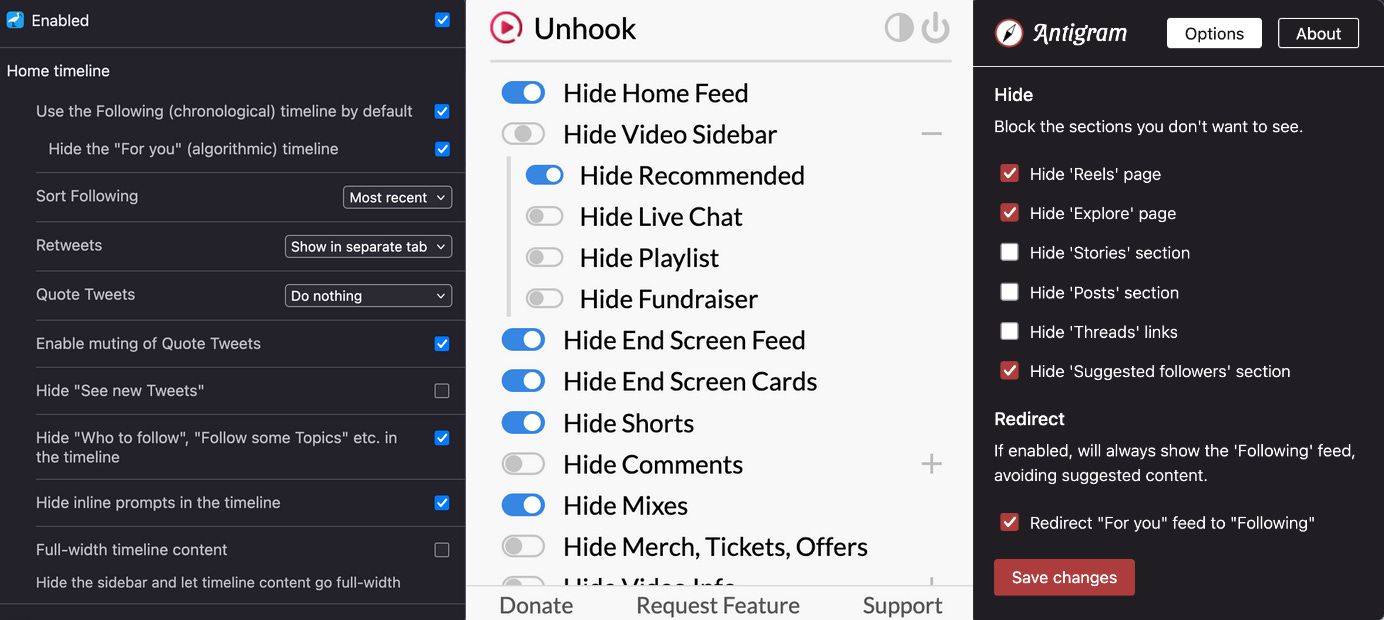
If you’re trying to make a popular site’s layout more aligned with your intentions, there’s probably an extension that can help you out.25
Revive Chronological Default Sequencing
The social media of yore functioned more like a public information utility than a media busines26s, giving you a simple rundown of what was happening now or near-now in the discourse. People complained for a week or so when the system changed, but ultimately accepted the new normal. While there have been years of broad and persistent criticism of AI replacing creatives like writers, photographers, videographers and musicians, the concerns around AI replacing editorial staff of the pre-feed era seemed more industry-specific. Personally, I continue to be more concerned about opaque editor-bots directing the attention of billions of people than I am about generative AI tools.27
To have more control over my own Twitter/X feed, I use Control Panel for Twitter. In the options menu, I can select the “Following” timeline to show tweets in chronological order, which gives me the same feeling of checking “what’s going on in the world” without having to worry about whether my interests are aligned with the AI of Twitter/X/Grok. (At the very least, they generally want me to spend more time on the site than I would like to; in the worst case scenario, they may have an interest in distorting my understanding of the world.)
What if it isn’t the chronological feed you miss but the way social media used to be more, well, social? The “Following” feed solves that too, but there are also other tools for other sites to address this challenge as well.
Maintain Intentional Community Focus
If you want to focus on your friends and your friends alone, that too can be managed with extensions.
On Instagram, I use the extension Antigram to default to a feed of exclusively those I follow. Admittedly, I do follow more than just friends, but I try to stick to just friends or small businesses as much as I can.
There are still some potential challenges here to prepare for. For example, the news accounts you follow will post much more frequently than your friends do, so if you really want to be community-focused, you’ll want to be particularly judicious with who you follow. You can always maintain multiple accounts for different follow lists to have a more news-oriented feed and a more social feed. (Or, like me, you might want to have a feed with accounts in a particular language optimized for language-learning.)
Ultimately, though, you can create a more local or otherwise-intentional feed to avoid being delivered more sensational algorithm-optimized content. It just may take a mix of extension setup and follow-list curation28. You have all winter though!
Set Time Limits
Another obvious way to use extensions is just to have them break you away from a distracting site after you’ve been on it for a certain amount of time.
I tend to redirect rather than set time-limits, but at early stages in using extensions to promote media mindfulness I made heavier use of the extensions StayFocusd and BlockSite. There are lots of extensions for this particular use case, so there’s a good chance the best one out there for you isn’t one I’ve used. The extension Limit looks pretty slick?
As a default approach, though, I’d encourage you to be strategic and defang a media service of its addictive mechanisms; it’s not always practically possible to directly manage the amount of time you spend on site. These services are good at capturing your attention, and your “five minute” time limit will come in the middle of you reading or watching something, and suddenly you’re circumventing the extension and trying to find the same content to finish, which will only take more time.
With web browser modifications, you can implement time limits, community focus, recency prioritization and dark pattern avoidance to keep your media services aligned with your interests. If you have to continue using a distracting media service, this is the best way to maintain control of the experience.
But what if you need to keep the app on your phone? There is one more line of defense to consider, though it is imperfect.
Hard Mode: Allow the application and website. Attempt to tame the algorithm.
It is important to remember, when trying to guide the algorithm, that it does not work for you. Its objective is to serve those who pay for its servers, and it does that by keeping you scrolling and seeing ads as long as possible. The algorithm doesn’t particularly care about your interests, so your ability to shape it is limited.
That said, there are two ways in many apps to attempt this feat, and the second is ultimately more effective than the first.
But let’s start with the first anyway.
Give Your Algo Feedback
This is the front-door to algorithm customer service. Most services provide some button to let the algorithm know you’re displeased with its selection. Usually, it’s easy to just scroll by, but Media Winter can be a good season to be a bit more proactively engaged. You can participate more actively in curation, investing in eventual higher quality recommendations.
When I see something that seems slop-adjacent or sensationalistic, I’ll not only flag that particular post/video, but I’ll spend five minutes just scrolling through as many recommendations as I can and block/unfollow accounts to better direct future recommendations. And depending on your goals, you can even “dislike” high-quality, interesting, informative content that simply doesn’t align with what you’re looking for from the app at this moment.
This can look different in different applications. You can go into the options on a recommended Instagram post and select “Not Interested”. Spotify has an option called “exclude from your taste profile” that you can select on songs and playlists, potentially helpful for those sharing accounts with children. I’m sure any app you’re trying to increase your agency within has a similar feature, and you just might need to fish around for it a little. And proactivity here can shape your recommendations.
Mostly.
Recall that the algorithm doesn’t work for you. While these systems aren’t transparent, I expect they do incorporate this feedback in some fashion, and they will in particular respect a direct block of a particular content source or creator. At the end of the day, the algorithm is trying to keep you on the app, and so it may still find ways to provide content similar to what it provided earlier if it believes that will keep you on the app.
If the algorithm anticipates you will watch a video, this tends to outweigh feedback you’ve provided.
Sometimes you have to help the recommendation system forget.

Lobotomize Your Algo
Many services will allow you to adjust your history, and this will be more effective at influencing your recommendations.
The main algorithm I do this with is YouTube29. YouTube lets you remove items from your history and comment on the algorithm. You’ll notice that it considers anything you even let autoplay without audio in your “history”, so even passive viewing behavior can influence your recommendations.
This may not be possible on every media platform you use, but when you can directly manipulate the context your algorithm is working with, it gives you more control over the recommendation experience.
Remember: The more mindfully you feed your feed, the more aligned your feed will be in feeding you.
Bonus Homework: Revisit Your Wrapped(s)
All the purging and purification can be a lot, so it can be good to offset that energy with something a bit more warm and fuzzy. Extending the “inter-year” transition doesn’t just give you more time for resolution-making, it also gives you more time for the end-of-year reflections that can feel rushed after the various holiday celebrations with family and friends. And one of my favorite ways to reflect is by digging into the “best of” lists: for movies, music, writing and more.
Further, I think observing “Old January” gives us all another month or so to put together our own “best of” lists. I will be using this extra time to do just that, and I’d encourage you to do the same. If you feel like you missed your chance to give your takes, consider this an extension.30
And while you reflect and select your favorite parts of the “old year”, you might find it useful to spend time with the various Wrapped-esque year-in-review reports you received. While these activity summaries seemed particularly overdone this year31, I think there is real value and meaning that can be drawn from them -- particularly when you’re able to space them out over the broader winter rather than cramming it all into a single-week nostalgia binge. And with the more relaxed timeline, you could even create your own year-in-review reports if you’re extra ambitious.
Extra and ambitious both describe me, so I’ll be using my January and February to practice some “Old Winter Revanchism” and share some analyses of my 2025 data to plan out my 2026. I’m hoping this will include some travel analysis, some updates on the survey system I ran all last year, and a cross-platform media self-audit. This last item will include (finally) completing the final newsletter in my Wrapped analysis trilogy that I started last year.

And on the topic of music, I have a track that I like to use to help remind myself to slow things down in January. It’s unfortunately been removed from Spotify, Apple Music and most dedicated music streaming services. It’s available though, to those willing to take the moment to be intentional and seek it out.
An Anthem for “Old January”
The evolution of January from deliberately passive to aggressively success-oriented is mirrored by the evolution of a pop-rap single that swept the radio waves in 2004. I associate the song with Star World Asia, a TV channel in Singapore that made heavy use of the song in promos when I lived there, which is a testament to the global resonance. But the song is a bit of a paradox.
The song I’m referring to is “Let’s Get It Started” by The Black Eyed Peas.
While “Let’s Get It Started” promotes the ambition, initiative and proactivity we associate with Contemporary January Culture, this was not the original message. Indeed, much like how Old January has roots in a season of rest and recuperation, the original lyrics preached the exact opposite message; that is, the song suggested, to paraphrase slightly, “Let’s [Slow Things Down]”.

There’s even evidence that the “Let’s [Slow Things Down]”/”Let’s Get It Started” song-cycle deliberately explores how developing the new requires an abandonment of the old. In the music video for “Let’s Get It Started”, the first half features the destruction of various objects, having them fall from great heights onto a street. Then, the second half plays the still-life snuff-films in reverse, letting the audience witness how the destruction enables creation. This is clearly a metaphor for the cycle of death and rebirth. This is the transition from old to new year. The front-facing face and back-facing face of the great Janus himself.
Though it’s hard to find this original version online32, I think January is a good month to revisit this lost track. It reflects an older view. I’m glad we have both versions of the song. A world with only “Let’s [Slow Things Down]” or only “Let’s Get It Started” would be a poorer world. We need both, a yin and yang that keep our lives in healthy balance. A song with a winter and summer version, a sort of modern superdistillation of Vivaldi’s “Four Seasons”.
Could un-cancelling “Let’s [Slow Things Down]” help reduce the toxic growth-oriented pressure that makes January 1st such a deadly day for suicides? Mass culture elevates and celebrates intellectual achievement constantly; by “purifying” the media of slowness-glorification, we create a high-pressure culture that drives us all toward anxiety and depression. We must maintain balance. And as far as songs that encourage relaxing one’s mental faculties, the track has the self-awareness to open with the line: “in this context, there’s no disrespect”. This is from the same album as “Where’s The Love”. Is this not a sort of inclusion?
Alas, you nor I can control the licensing and distribution strategies of a multi-platinum alt-hiphop collective. You can only control your own approach to January.
So I compel you: Don’t “get it started”. Not yet. Slow things down.
Let yourself breathe all the way out. Make lungspace for a nourishing inhalation to come.
There’s a new year ready for you33, whenever you’re ready for it.
Or those who observe the new year January 2nd through 12th, though I am not aware of anyone who does!
At date of publication it is 108 days until May Day, closer to May Day today than when I released my May Day post!
The decree was carved into stone and is currently on display in the Cairo museum. Which raises a question. Would you rather your calendar decree: (a) be totally ignored and lost forever? or (b) be ignored but discovered by archeologists millennia later so everyone realizes how ineffective you were at decrees?
That’s five “great-” prefixes totally. You could also say “Cleopatra was the great-granddaughter of Ptolemy III’s great-great-grandson”, avoiding an extended repetition of prefixes. And because of all the inter-marriage, Cleopatra is not just Ptolemy III’s quinta-great-granddaughter but his sexta-great-granddaughter and septa-great-granddaughter as well. The dynasty’s wisdom about calendars did not extend into genetics.
Recognizing the Cleopatrian Calendar could have a real impact on the discourse. I could see it becoming a Woke trend to refer to “July” (from Julius Caesar) as “Cleo” (from Cleopatra) to acknowledge Cleopatra’s and Egypt’s roles in creating the calendar. As in, “If you can’t make our Juneteenth BBQ, we’re also having a smaller and less important gathering on the 4th of Cleo.” And for the actively non-Woke: “I can’t be racist; my calendar’s from Africa!” We’re all winners here.
It made great use of audio just as you would expect from Radiolab co-creator Jad Abumrad; if this sounds interesting to you, I strongly recommend either starting at the beginning or with the third episode “Enter the Shrine”.
In his defense, the label “Julian Calendar” wasn’t used during his lifetime. (Or put more confusingly: It was named after him after him.)
Critical consensus seems to be that his murder was not about the calendar at all and was more about all the tyranny stuff. Which, you know, makes sense as a theory too.
Known as just “Ptolemy”, this Ptolemy was distinct from the many rulers named Ptolemy in that he published broadly about music, mathematics and the stars, and also in that he probably had four distinct grandparents that weren’t also his aunts/uncles.
This is often cited as Pope Gregory specifically being concerned about how Easter was drifting further away from the equinox, but my interpretation is that the alignment was necessary to practice the Ptolemaic astrology still popular today. Though astrology is not considered a part of modern canonical Roman Catholicism, back in the 1500s they were boosting it along with Ptolemy’s earth-centered model of the universe. (The official guidance against astrology was added to the catechism only in 1992.)
I do not intend this to come across as critical; I personally love magic books, which is why I wrote about my favorite passages from them across cultures.
“An Act for regulating the Commencement of the Year, and for correcting the Calendar now in Use”, which changed the calendar and thus many birthdays, was passed through British Parliament, meaning it was only official after receiving “royal assent” through a crown-delegated Lord Commissioner. This was largely a formality but I think it’s still technically accurate to say that King George II changed the birthdays of many Founding Fathers without providing them representation in parliament, even if only by proxy and only as a formality.
Carter Braxton is not a named character in Hamilton, but you’re allowed to pretend he’s one of the unnamed characters in the ensemble.
It was a great coffee shop, and you should visit, but you can’t, because it’s lost to the past. Just. Like. The. Old. Year. (Whoa.)
A clarification here is that by calling the big graph of winter deaths “Mount SAD”, I may have implied that the deaths represented are deaths of despair -- indeed, only New Year’s Day is notably high on this particular kind of deaths, the rest is due to increases in cardiovascular and respiratory illnesses. A friend of mine wrote a good debunker on how December actually has fewer suicides than other months of the year. (Indeed, postponing tragic plans until after the holidays may be one of the drivers of the early January bump.)
Not totally wrong as far as I understand it?
After the “creation” of February, it was celebrated on February 15th, so if you’re looking to counterprogram Valentine’s Day then you could always plan your phone purge for then.
It is its own essay, but most major ancient global value systems are critical of gossip. One way to define gossip is talking to someone about someone else. Pretty much all news meets this definition. You make progress by talking directly to people. (Note that I run this newsletter always trying to speak to you directly and help with common challenges you may have!) If you unsubscribe to news notifications, know that a rainbow coalition of wise ancients are smiling upon you.
In seriousness, though, I do want to do a better job of keeping these newsletters aimed at helping all my readers get more out of their media diet while reducing the discomfort and anxiety media can create! If you feel I’m not doing that, please call me out and I’ll tune my approach appropriately!
As a young professional working with television studios and networks, I replaced a lot of my social media time with The Hollywood Reporter and Deadline. When I got out of that industry, those publications were still a habit, but became distractions for me. So the same publication can be aligned or misaligned for you in different chapters of your life. This is part of why it’s useful to do a winter ritual like this annually -- as we move through life, our media needs change!
Admittedly I have access to many of my paid services through family members, so I would use a Block or Redirect solution here instead.
Some applications are “mixed-use”, and in this case you can take different actions on different machines. I have a mix of more work-adjacent and less work-adjacent Slack channels I participate in, and so I try to keep my phone more focused on work-adjacent channels while allowing all channels on my laptop.
When downloading extensions from unknown developers, I’ll sometimes have an LLM chatbot inspect the code for anything nefarious as a way to ease concerns that it’s sharing/storing data that I don’t want it to.
Some of these may not meet everyone’s definition of a “dark pattern”, but I think any feature within a media service that tries to get you to act against your self-interest is at least a “gray pattern”.
You can also use ChatGPT or an LLM to design your own custom extension, but that’s perhaps complex enough to cover in another newsletter.
I know I made a crack about the “abundance agenda”, but Abundance co-author Derrick Thompson’s “Everything Is Television” explains this transition and problem astutely.
A media ecosystem that combines AI-generation and AI-recommendation is likely worse than one that contains either individually, and that seems to be where we’re increasingly at.
Curating your own follow list is substantial work, so it’s no surprise that many people are happy to let Instagram do that work for them!
For me personally, I keep some YouTube content downloaded on my phone to watch on plane rides, and that means I want to keep the app on my phone, even though it can occasionally be a distraction.
The Oscars are more or less on this schedule this year, choosing March 15th to honor the best movies of 2025. Somewhere, the old Romans are smiling.
Case in point: SNL made fun of the idea of an Uber Eats Wrapped in its December 13th, and then that following Monday Uber Eats unironically released their own Wrapped. (They called it “Youber”.)
If you aren’t familiar with the original, just look up “black eyed peas lets get it started original title” and then find that on YouTube. There’s discomfort around the particular vocab, and there’s certainly no pressure. As for me, I’ve scored levels on various psychological tests that qualify me to listen to it -- though probably not sufficient to sing along. (You’ll also find in YouTube comments that many neurodiverse people identify with the song; it’s not just me.) I wouldn’t advise putting it in your karaoke rotation, but a few listens as you transition between years is okay.
Lunar New Year is February 17th this year. Spring Equinox is either March 21st or 22nd depending on your time zone. The UK’s old new year would start on “Lady Day” or March 25th. I have a late February birthday that I am setting as my milepost, and you’re welcome to join me.